- Written by: Naveen Singh
- June 4, 2026
- Categories: Blog, SEO Strategy
- Tags: , Best CRO Services, Best Digital Marketing Services in India, CRO, Digitianera
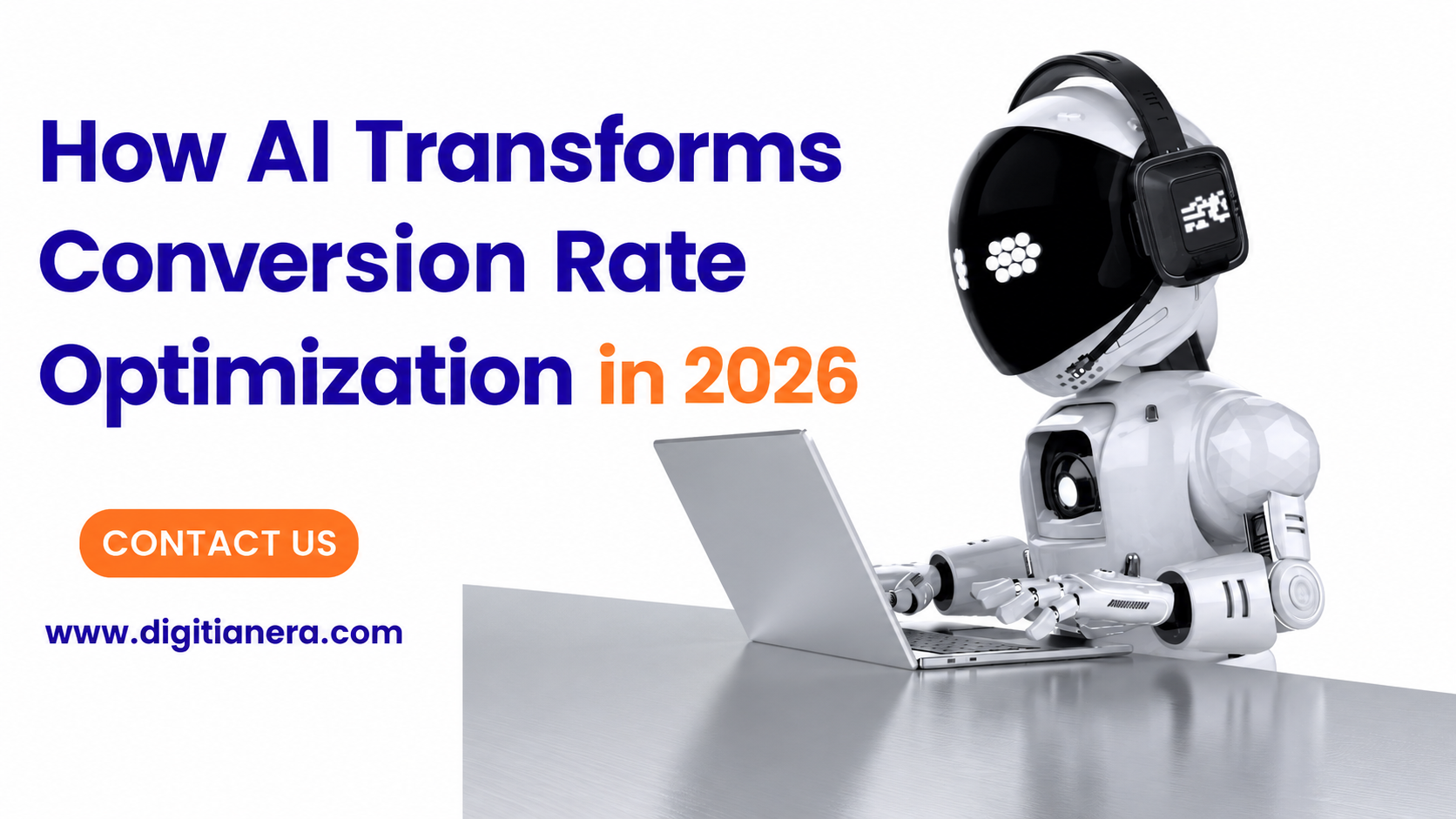
How AI is Transforming Conversion Rate Optimization (CRO) in 2026
The digital marketing landscape is evolving faster than ever, and businesses can no longer rely solely on increasing website traffic to drive growth. In 2026, the real competitive advantage lies in converting existing visitors into paying customers. This is where Conversion Rate Optimization (CRO) becomes essential.
Traditionally, CRO involved extensive manual testing, data analysis, and experimentation. Marketers would spend weeks testing headlines, landing pages, call-to-action buttons, and user journeys before identifying improvements. While effective, this approach was often time-consuming and limited by human interpretation.
Today, Artificial Intelligence (AI) is fundamentally changing how businesses approach CRO.
AI-powered technologies can analyze massive amounts of user data in real time, identify behavioral patterns, predict user intent, and automatically optimize website experiences without requiring constant manual intervention. Instead of waiting weeks for test results, businesses can now make data-driven decisions instantly.
At Digitianera, we believe AI-driven CRO represents the future of digital growth. By combining advanced AI capabilities with proven conversion optimization strategies, businesses can deliver personalized experiences, increase engagement, and maximize revenue from every visitor.
In this guide, we’ll explore how AI is revolutionizing Conversion Rate Optimization in 2026 and how businesses can leverage these innovations to achieve sustainable growth.
What is AI-Powered Conversion Rate Optimization?
AI-powered Conversion Rate Optimization refers to the use of Artificial Intelligence, Machine Learning, and predictive analytics to improve website performance and increase conversions automatically.
Rather than relying solely on manual A/B testing and historical reports, AI continuously learns from visitor interactions and identifies opportunities to improve the user experience.
AI-powered CRO systems can:
- Analyze visitor behavior in real time
- Predict purchasing intent
- Personalize website content dynamically
- Optimize landing pages automatically
- Improve customer journeys
- Reduce conversion barriers
- Generate actionable insights instantly
This allows businesses to make smarter decisions faster while delivering more relevant experiences to users.
The result is higher conversion rates, better customer satisfaction, and improved marketing ROI.
Why AI-Powered CRO Matters in 2026
Consumer expectations have changed dramatically.
Modern users expect:
- Personalized experiences
- Instant responses
- Seamless navigation
- Relevant recommendations
- Frictionless purchasing journeys
If a website fails to meet these expectations, visitors quickly move to competitors.
AI helps businesses adapt to these changing demands by analyzing user behavior continuously and making real-time adjustments that improve engagement and conversions.
Companies that embrace AI-driven CRO gain a significant advantage by understanding customer needs before competitors do.
Key Ways AI is Transforming CRO in 2026
1. Hyper-Personalization at Scale
Personalization has become one of the most powerful conversion drivers.
In the past, businesses could only segment users into broad categories. Today, AI enables one-to-one personalization for every visitor.
AI analyzes factors such as:
- Location
- Device type
- Traffic source
- Browsing history
- Previous purchases
- Session behavior
- Demographics
Using this information, websites can automatically display:
- Personalized headlines
- Custom product recommendations
- Dynamic offers
- Tailored content
- Relevant CTAs
For example, a returning visitor may see a special discount offer, while a first-time visitor sees educational content designed to build trust.
This level of personalization significantly increases engagement and conversion rates.
2. Predictive User Behavior Analysis
One of AI’s biggest advantages is its ability to predict future actions.
Instead of simply analyzing past behavior, AI identifies patterns that indicate what users are likely to do next.
Predictive analytics can help businesses identify:
- Visitors likely to convert
- Users at risk of leaving
- Potential cart abandoners
- High-value prospects
- Repeat purchase opportunities
These insights allow marketers to take proactive actions before users leave the website.
For example:
- Triggering targeted offers
- Sending personalized messages
- Providing assistance through live chat
- Offering limited-time incentives
By addressing user needs in real time, businesses can dramatically improve conversion rates.
3. Automated A/B Testing and Continuous Optimization
Traditional A/B testing often requires weeks or months to produce statistically significant results.
AI changes this process completely.
Modern AI-powered testing platforms continuously test multiple variations simultaneously and automatically allocate traffic to the highest-performing versions.
AI can optimize:
- Headlines
- Images
- Landing pages
- CTA buttons
- Forms
- Product descriptions
- Navigation structures
Instead of waiting for reports, businesses benefit from continuous optimization happening behind the scenes.
This leads to faster improvements and more efficient experimentation.
4. AI-Driven User Experience (UX) Optimization
User experience directly impacts conversion rates.
Even small usability issues can lead to significant revenue losses.
AI-powered analytics tools can identify:
- Confusing navigation paths
- High-exit pages
- Form abandonment points
- Friction in checkout processes
- Areas where users hesitate
Unlike traditional analytics, AI doesn’t just show what happened—it explains why it happened.
Businesses can then make targeted improvements that remove friction and streamline customer journeys.
The result is a smoother experience that encourages users to complete desired actions.
5. Smart Chatbots and Conversational CRO
AI chatbots have evolved far beyond simple scripted responses.
Modern conversational AI can:
- Answer complex questions
- Recommend products
- Assist with purchases
- Qualify leads
- Schedule appointments
- Provide personalized support
These interactions help eliminate uncertainty and guide users toward conversion.
For many businesses, AI chatbots function as 24/7 sales representatives, helping visitors find information instantly without leaving the website.
This significantly improves engagement and customer satisfaction.
6. AI-Powered Copywriting and CTA Optimization
Messaging plays a crucial role in CRO.
AI tools can now analyze user responses and automatically generate multiple versions of:
- Headlines
- Product descriptions
- Email copy
- Ad creatives
- CTA buttons
By continuously testing messaging variations, AI identifies which language resonates most with specific audience segments.
Even minor wording adjustments can lead to substantial conversion improvements.
Businesses no longer need to rely solely on guesswork when creating persuasive content.
Benefits of AI in Conversion Rate Optimization
Higher Conversion Rates
AI identifies opportunities that traditional analytics often miss, leading to improved website performance.
Better User Experiences
Personalized experiences create stronger engagement and customer satisfaction.
Faster Decision-Making
AI analyzes large datasets instantly, helping businesses make informed decisions quickly.
Reduced Marketing Costs
Improved conversion rates mean businesses generate more revenue without increasing advertising spend.
Increased Revenue
Optimized customer journeys result in higher average order values and more completed transactions.
Continuous Improvement
AI systems continuously learn and optimize, ensuring long-term growth.
Challenges of AI-Powered CRO
While AI offers significant advantages, businesses must also address several challenges.
Data Quality Issues
AI relies heavily on accurate and structured data. Poor data quality can reduce optimization effectiveness.
Privacy and Compliance
Businesses must ensure compliance with regulations such as GDPR and evolving data privacy standards.
Integration Complexity
Implementing AI tools may require integration with existing marketing platforms and analytics systems.
Human Oversight
AI provides valuable insights, but strategic decisions still require human expertise and creativity.
The most successful CRO strategies combine AI intelligence with experienced marketing professionals.
Future Trends in AI and CRO Beyond 2026
Several emerging trends are expected to shape the future of CRO:
Predictive Personalization
Websites will adapt before users even express intent.
Emotion-Based Optimization
AI will analyze behavioral signals to understand emotional states and adjust experiences accordingly.
Autonomous Marketing Systems
AI platforms will automatically optimize entire customer journeys with minimal human intervention.
Advanced Voice Search Experiences
Voice-driven interactions will become a critical conversion channel.
Real-Time Dynamic Websites
Websites will continuously evolve based on individual user behavior and market trends.
Businesses that adopt these innovations early will gain a significant competitive advantage.
How Businesses Can Adapt
To succeed in the AI-driven CRO era, businesses should:
- Invest in accurate data collection
- Focus on customer behavior analysis
- Implement AI-powered optimization tools
- Continuously test and improve experiences
- Prioritize personalization
- Maintain strong privacy practices
- Combine AI insights with human expertise
Organizations that embrace AI strategically will be better positioned for long-term growth.
Conclusion
Artificial Intelligence is no longer a futuristic concept in Conversion Rate Optimization—it is the driving force behind modern digital growth.
From hyper-personalization and predictive analytics to automated testing and intelligent customer experiences, AI is transforming how businesses convert website visitors into loyal customers.
In 2026, companies that leverage AI-powered CRO gain a clear advantage by delivering more relevant experiences, improving marketing efficiency, and maximizing revenue opportunities.
At Digitianera, we help businesses harness the power of AI-driven digital marketing strategies to increase conversions, enhance customer experiences, and achieve sustainable growth.
The future of CRO is intelligent, personalized, and data-driven—and that future is already here.