- Written by: Naveen Singh
- August 31, 2026
- Categories: Blog, AI SEO
- Tags: , AI search optimization, AI search optimization. AI-powered SEO. AI SEO services. AI search results. SEO in 2026, AI search visibility, AI SEO optimization, AI SEO strategy, AI-powered search, generative AI search, Google AI Mode, Google AI Overviews, Google AI Search, SEO for AI search
AI SEO in 2026: How to Optimize Your Website for Google AI Search
Search has changed dramatically in recent years. With Google AI Overviews, AI Mode, conversational search, and generative AI platforms such as ChatGPT, Gemini, Perplexity, and Microsoft Copilot, people are no longer searching online in exactly the same way they used to.
Instead of typing short keywords and opening several websites, users increasingly ask complete questions and expect quick, accurate, and useful answers.
This change creates a major opportunity for businesses that understand AI SEO and adapt their websites accordingly.
However, AI does not mean traditional SEO is dead. Search engines still need to discover, crawl, index, understand, and evaluate websites before their information can be used in search experiences. Strong technical SEO, helpful content, authority, and trust therefore remain essential.
At Digitianera, we believe the future of search belongs to businesses that combine human expertise, high-quality content, technical optimization, and AI-ready search strategies. The goal should not be to create content simply for algorithms. Instead, businesses should create resources that genuinely answer users’ questions and demonstrate real expertise.
In this guide, you will learn what AI SEO means, how Google AI search is changing user behaviour, and the practical steps businesses can take to improve visibility in the evolving search landscape.
In this guide, you will learn what AI SEO means, how Google AI search is changing user behaviour, and the practical steps businesses can take to improve visibility in the evolving search landscape.
What Is AI SEO?
AI SEO is the process of optimizing a website, its content, and its overall search presence for search experiences that use artificial intelligence to understand queries and generate answers.
Traditional search primarily presents a list of relevant webpages. AI-powered search can interpret a user’s question, combine information from multiple sources, and provide a conversational summary.
Google’s AI-powered search experiences include features such as:
- AI Overviews
- AI Mode
- Conversational Search
- Multi-step search queries
- Context-aware results
- Personalized search experiences
- Visual search
- Voice search improvements
For example, a user may previously have searched:
“Best SEO strategy for e-commerce”
Today, they may ask:
“How can a small e-commerce business increase organic traffic without spending a large amount on advertising?”
The second query communicates much more context and intent.
This means businesses should move beyond simply targeting individual keywords. Their content should answer complete questions, address related topics, and provide clear information that satisfies the user’s underlying intent.
For a deeper understanding of how Google approaches generative AI search, businesses can also review Google’s guidance on generative AI search.
Why SEO Still Matters in 2026
A common misconception is that artificial intelligence will completely replace SEO. In reality, AI-powered search still depends on information that search engines can discover, understand, evaluate, and trust.
Before content can potentially appear in AI-generated search experiences, search systems need to understand the website and its information.
Important foundations include:
- Crawling and accessibility
- Proper indexing
- Relevant content
- Technical SEO
- Topical authority
- Expertise
- Trustworthiness
- Positive user experience
This is why AI SEO should be viewed as an evolution of SEO rather than a replacement for it.
If a website has poor technical foundations, weak content, or limited authority, AI systems may have difficulty understanding and confidently using its information.
Businesses should therefore continue investing in traditional SEO while adapting their content and website strategy for AI-powered search.
How AI Search Is Changing User Behaviour
Search behaviour is becoming more conversational and question-driven.
Users increasingly want:
- Direct answers instead of long lists of links.
- Clear comparisons between products or services.
- Summarized information from multiple sources.
- Answers to complex questions.
- Personalized and contextual information.
- Voice and visual search experiences.
This change makes content quality increasingly important.
For example, instead of publishing an article that repeatedly uses the phrase “SEO services,” a business can create a detailed resource explaining how different SEO strategies work, who they are suitable for, what results businesses can expect, and what factors influence performance.
The content becomes useful because it answers the questions a potential customer actually has.
A successful AI SEO strategy therefore starts with understanding people rather than simply adding more keywords to a page.
Understanding Search Intent in the AI Era
Search intent describes the reason behind a user’s query.
Understanding intent is especially important when optimizing content for AI-powered search because conversational queries often contain several requirements within one question.
Informational Intent
The user wants to learn something.
Example:
“What is technical SEO?”
Navigational Intent
The user wants to find a specific website or brand.
Example:
“Digitianera SEO services”
Transactional Intent
The user is ready to take action.
Example:
“Hire an SEO expert”
A strong content strategy should address different stages of the customer journey instead of creating content around only one type of search.
The Rise of Experience-Based Content
AI can generate general explanations of common topics. Because of this, simply rewriting information that already exists online may provide limited value.
Businesses should add information that demonstrates genuine experience.
Experience-based content can include:
For example, instead of publishing:
“10 SEO Tips”
a business could publish:
“How We Increased Organic Traffic by 350% Using Technical SEO and Content Clusters.”
The second topic has a stronger experience element because it can explain what was actually done, what changed, and what was learned.
This type of original information can make content more useful and differentiate it from generic material.
Why E-E-A-T Matters More Than Ever
Google’s quality framework emphasizes four important concepts:
Experience
Demonstrate first-hand knowledge and practical experience.
Expertise
Show a strong understanding of the subject.
Authoritativeness
Build recognition through quality content, industry mentions, and relevant links.
Trustworthiness
Provide accurate, transparent, and reliable information.
Businesses can strengthen these signals by:
- Adding clear author information.
- Showing relevant credentials or certifications.
- Publishing genuine case studies.
- Including testimonials where appropriate.
- Citing reliable sources.
- Updating outdated information.
- Providing transparent business and contact information.
Strong E-E-A-T signals can support the broader goals of AI SEO by making a website’s expertise and reliability clearer to users and search systems.
Building Topical Authority
Instead, businesses should develop topic clusters around their core services.
For a digital marketing agency, relevant clusters could include:
- SEO
- AI SEO
- Technical SEO
- Local SEO
- E-commerce SEO
- Link Building
- Content Marketing
- PPC Advertising
- Social Media Marketing
- Conversion Rate Optimization
For example, an SEO pillar page could link naturally to supporting articles about technical SEO, local SEO, keyword research, internal linking, and content optimization.
This creates a connected content ecosystem.
It also helps users discover additional information without returning to the search results.
Technical SEO for AI Search
High-quality content alone cannot compensate for serious technical problems.
A website should provide a strong technical foundation that allows search engines to access and understand its pages.
Important technical SEO elements include:
- Fast page loading
- Mobile-friendly design
- HTTPS security
- XML sitemap
- Correct robots.txt configuration
- Canonical tags
- Structured data
- Core Web Vitals
- Internal linking
- Clean URL structures
- Image optimization
Technical SEO supports AI SEO because search systems need to access and interpret website content before that information can contribute to search visibility.
Structured Data and Schema Markup
Structured data helps search engines understand the meaning and context of webpage information.
Depending on the website, useful schema types may include:
- Organization
- Local Business
- Article
- Product
- Review
- Breadcrumb
- Service
- Person
- FAQ
Schema should be implemented accurately and should reflect the actual content of the page.
It should not be treated as a shortcut for achieving visibility. Instead, structured data is one part of a broader technical and content strategy.
Optimizing Content for Google AI Overviews
There is no guaranteed formula for appearing in AI-generated search results. However, businesses can make their content easier to understand and use by following strong content practices.
Consider these approaches:
- Answer important questions directly.
- Use descriptive headings.
- Keep explanations clear and concise.
- Organize complex information into lists.
- Use comparison tables where useful.
- Provide evidence for important claims.
- Include original examples.
- Address related questions users may have.
- Keep information accurate and updated.
- Content should be written for people first.
The objective of AI SEO is not to manipulate AI systems. It is to make useful information easier for search systems and users to understand.
AI SEO vs Traditional SEO
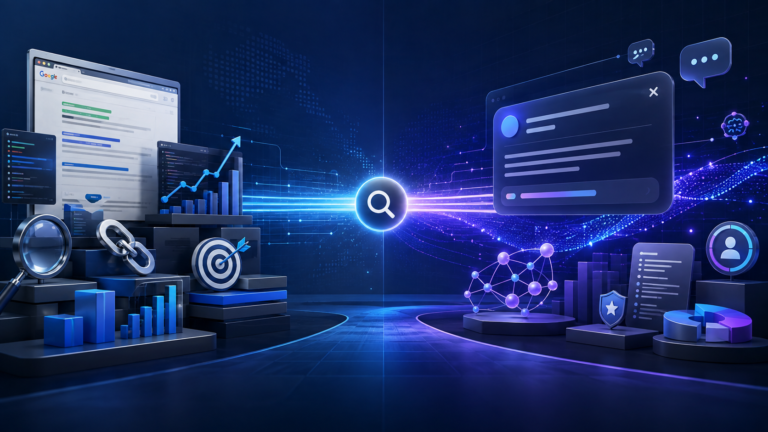
Although the two approaches overlap heavily, their emphasis can differ.
| Traditional SEO | AI SEO |
|---|---|
| Focuses heavily on search engine rankings | Focuses on visibility across AI-powered search experiences |
| Often targets specific keywords | Targets topics, intent, entities, and conversational questions |
| Optimizes pages for traditional search results | Optimizes information for AI-generated answers and search experiences |
| Uses technical SEO, content, and backlinks | Combines SEO with helpful content, authority, experience, and clear answers |
| Measures rankings and organic traffic | Also considers visibility and mentions across AI-powered experiences |
The important point is that businesses do not need to choose between the two.
Traditional SEO provides many of the technical and content foundations required for modern search optimization.
Internal Linking Strategy
Internal linking is an important part of a strong website architecture.
Relevant internal links can:
- Help search engines discover pages.
- Connect related topics.
- Strengthen topical relevance.
- Distribute authority throughout the website.
- Improve navigation.
- Encourage users to explore additional content.
For example, an article about AI-powered search could naturally link to related resources about SEO services, technical SEO, content marketing, and other relevant topics.
Links should always be contextually useful rather than added simply to increase the number of internal links.
Visual Content Optimization
Search is no longer limited to text.
Images, videos, graphics, screenshots, and other visual formats can improve how users understand information.
Businesses can create:
- Original infographics
- Educational graphics
- Explainer videos
- Product screenshots
- Comparison charts
- Step-by-step visuals
Every image should have a descriptive filename and appropriate alt text.
Image files should also be compressed to maintain page performance without unnecessarily reducing quality.
Visual optimization can complement AI SEO by making content more useful across increasingly multimodal search experiences.
Common AI SEO Mistakes to Avoid
Businesses often make mistakes when adapting to AI-powered search.
Common problems include:
- Publishing large amounts of low-quality AI-generated content.
- Focusing on keyword repetition instead of user intent.
- Ignoring technical SEO.
- Publishing thin content.
- Failing to update outdated information.
- Copying information from other websites.
- Ignoring mobile experience.
- Creating disconnected articles without internal links.
- Making unsupported claims.
- Treating AI optimization as a replacement for traditional SEO.
The strongest approach is to use AI as a tool while maintaining human review, expertise, accuracy, and originality.
AI SEO Checklist for 2026

Use this checklist when reviewing your website:
- Create people-first content.
- Demonstrate real experience.
- Understand search intent.
- Improve page speed.
- Optimize for mobile devices.
- Build topic clusters.
- Add relevant structured data.
- Strengthen internal linking.
- Publish original visuals.
- Update older content.
- Earn relevant, quality backlinks.
- Demonstrate E-E-A-T.
- Answer real customer questions.
- Monitor Core Web Vitals.
- Track organic and AI-related search visibility.
Regularly reviewing these areas can help businesses build a stronger foundation for the future of search.
How Digitianera Can Help
At Digitianera, we help businesses adapt their digital presence to the changing search landscape.
- AI SEO Optimization
- Technical SEO Audits
- Local SEO
- E-commerce SEO
- Content Marketing
- Link Building
- Website Development
- Performance Marketing
- Conversion Rate Optimization
- WordPress SEO
- EO Consulting
Our approach combines human expertise, data-driven decision-making, useful content, and modern search optimization.
Rather than chasing short-term ranking tricks, we focus on building a strong online presence that can support long-term organic growth.
Whether you need a technical SEO audit, content optimization, or a broader search strategy, Digitianera can help you prepare your website for the next generation of search.
Frequently Asked Questions (FAQs)
What is AI SEO?
AI SEO is the process of optimizing website content, technical elements, and overall search visibility for AI-powered search experiences while maintaining strong traditional SEO foundations.
Is SEO still important with AI-powered search?
Yes. Search engines still need to discover, crawl, index, understand, and evaluate web content. Strong technical SEO, useful content, authority, and trust therefore remain important.
How can I optimize my website for AI search?
Start with helpful, people-first content. Understand search intent, answer questions clearly, demonstrate experience, improve technical SEO, build topical authority, use relevant structured data, and strengthen internal linking.
Can AI-generated content rank on Google?
AI-assisted content can perform when it provides useful, accurate, original, people-first information. Simply producing large quantities of automatically generated content without meaningful value or human review is not a reliable search strategy.
Can Digitianera help with AI SEO?
Yes. Digitianera provides SEO and digital marketing solutions that can help businesses improve technical foundations, content quality, topical authority, and visibility across modern search experiences.
Conclusion
Artificial intelligence is transforming how people discover information online, but it does not eliminate the importance of search optimization.
The future is moving toward websites that provide useful answers, demonstrate genuine expertise, maintain strong technical foundations, and consistently deliver a trustworthy user experience.
Businesses that adapt early can build stronger visibility across both traditional search results and emerging AI-powered search experiences.
The goal should not simply be to rank for more keywords. It should be to become a reliable source of information within your industry.
A well-planned AI SEO strategy combines the fundamentals of SEO with helpful content, search intent, topical authority, technical performance, and genuine expertise.
If you want to prepare your website for the changing search landscape, Digitianera can help you build a practical strategy focused on sustainable organic growth.
Start optimizing today and prepare your business for the next generation of search.