
- Written by: Naveen Singh
- June 25, 2026
- Categories: Blog, SEO Strategy
- Tags: , Best SEO Services in India, Digitianera Services, SEO Analysis Report, SEO Services, SEO Strategy
How to Create an SEO Analysis Report for Better Rankings in 2026
In today’s highly competitive digital landscape, simply launching a website is not enough to attract customers and grow your business. Millions of websites compete for visibility on search engines like Google every day. As search algorithms continue to evolve, businesses must continuously monitor and improve their websites to maintain strong search rankings and organic traffic. This is where an SEO Analysis Report becomes one of the most valuable tools for digital growth. An SEO analysis report provides a comprehensive evaluation of your website’s performance in search engines. It helps identify technical issues, content gaps, keyword opportunities, user experience problems, and backlink weaknesses that may be preventing your website from reaching its full potential.
Whether you are a small business owner, digital marketer, SEO professional, or eCommerce brand, understanding your website’s SEO health is the first step toward achieving sustainable online growth. A well-structured SEO analysis report not only highlights existing problems but also provides actionable recommendations that can improve rankings, increase traffic, generate leads, and boost conversions.
In this comprehensive guide, you’ll learn everything about SEO analysis reports, including their importance, key components, common SEO issues, best tools, and how to create a detailed SEO report that drives real business results.
What Is an SEO Analysis Report?
An SEO Analysis Report is a detailed evaluation of a website’s search engine optimization performance. It analyzes various factors that influence a website’s visibility on search engines, including technical SEO, on-page optimization, content quality, backlinks, keyword rankings, user experience, and competitor performance.
Think of an SEO analysis report as a health checkup for your website. Just as a doctor examines different aspects of your health before recommending treatment, an SEO report examines multiple elements of your website to identify strengths, weaknesses, and opportunities for improvement.
The primary objective of an SEO analysis report is to answer important questions such as:
- Why is my website not ranking?
- Which pages are driving traffic?
- What technical issues need fixing?
- How strong is my backlink profile?
- Which keywords should I target?
- How does my website compare to competitors?
A comprehensive SEO report transforms complex data into actionable insights that help businesses make informed marketing decisions.
Why Is an SEO Analysis Report Important?
Many businesses invest heavily in website development, content marketing, social media, and paid advertising. However, without regular SEO audits, they often struggle to understand why their website isn’t performing as expected.
An SEO analysis report helps businesses identify hidden issues that may be limiting growth and provides a roadmap for improvement.
Improve Search Engine Rankings
One of the primary benefits of an SEO analysis report is identifying factors that prevent your website from ranking higher in search results. Technical errors, poor content optimization, slow page speed, and weak backlinks can all negatively impact rankings.
By addressing these issues, businesses can significantly improve their visibility on Google.
Increase Organic Traffic
Organic traffic is one of the most cost-effective sources of website visitors. An SEO analysis report helps uncover keyword opportunities, content gaps, and technical improvements that can attract more qualified traffic to your website.
Enhance User Experience
Search engines increasingly prioritize user experience. Factors such as page speed, mobile responsiveness, navigation, and content readability influence both rankings and conversions.
SEO audits help improve these elements, creating a better experience for visitors.
Stay Ahead of Competitors
Competitor analysis is a crucial part of SEO reporting. By understanding what competitors are doing well, businesses can identify opportunities to outperform them and gain market share.
Maximize Return on Investment
Rather than making random SEO changes, businesses can focus on high-impact improvements based on real data, ensuring better ROI from their marketing efforts.
Key Components of an SEO Analysis Report
A complete SEO analysis report consists of several important sections that evaluate different aspects of website performance.
Technical SEO Analysis
Technical SEO forms the foundation of every successful SEO strategy. If search engines cannot properly crawl, index, and understand your website, even the best content may struggle to rank.
Website Crawlability
Search engines use automated bots to crawl websites and discover content. If these bots encounter obstacles, important pages may never appear in search results.
A crawlability audit checks for:
- Broken links
- Crawl errors
- Redirect chains
- Blocked resources
- Orphan pages
- Server errors
Resolving crawlability issues helps search engines access and index your content more effectively.
Indexation Analysis
Indexation determines whether your pages appear in Google’s search index.
Common issues include:
- Pages blocked by robots.txt
- Incorrect noindex tags
- Duplicate pages
- Canonicalization errors
An SEO report identifies pages that should be indexed but are currently excluded from search results.
Website Speed and Core Web Vitals
Page speed directly impacts user experience and rankings.
Google measures performance using Core Web Vitals:
Largest Contentful Paint (LCP)
Measures loading performance.
Target:
Less than 2.5 seconds
Interaction to Next Paint (INP)
Measures responsiveness.
Target:
Less than 200 milliseconds
Cumulative Layout Shift (CLS)
Measures visual stability.
Target:
Below 0.1
Improving these metrics can significantly enhance both rankings and user satisfaction.
Mobile-Friendliness
Google uses mobile-first indexing, meaning it primarily evaluates the mobile version of your website.
An SEO report examines:
- Responsive design
- Mobile usability
- Page speed on mobile devices
- Touch element spacing
- Mobile navigation
A poor mobile experience can lead to lower rankings and lost conversions.
HTTPS Security
Security is another important ranking factor.
An audit verifies:
- SSL certificate installation
- HTTPS implementation
- Mixed content issues
- Security vulnerabilities
Secure websites build trust and improve search performance.
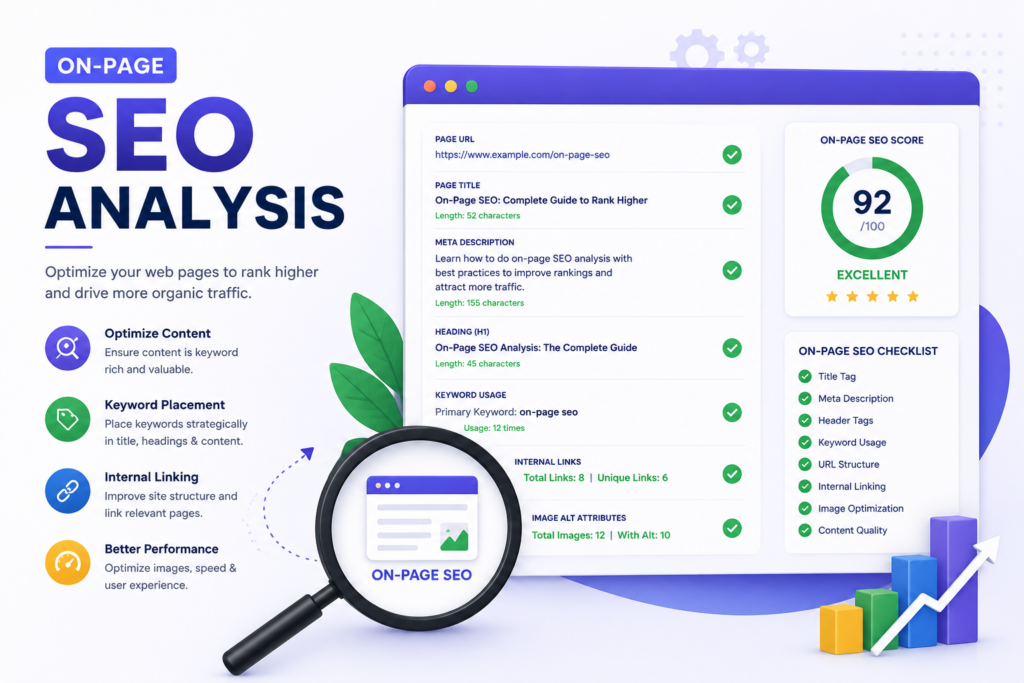
On-Page SEO Analysis
On-page SEO focuses on optimizing individual pages to improve search visibility and user engagement.
Title Tags
Title tags are among the most important ranking factors.
A strong title tag should:
- Include the primary keyword
- Remain under 60 characters
- Encourage clicks
- Be unique for each page
Example:
SEO Analysis Report: Complete Guide to Better Rankings
Meta Descriptions
Although meta descriptions are not direct ranking factors, they significantly influence click-through rates.
Best practices include:
- Keeping descriptions under 160 characters
- Including relevant keywords
- Using compelling calls-to-action
Heading Structure
Proper heading hierarchy improves readability and SEO.
A well-optimized page should include:
- One H1 tag
- Multiple H2 headings
- Supporting H3 headings
Headings help search engines understand content structure and relevance.
URL Optimization
SEO-friendly URLs are short, descriptive, and keyword-rich.
Good Example:
yourwebsite.com/seo-analysis-report
Bad Example:
yourwebsite.com/page?id=123
Clean URLs improve both user experience and crawlability.
Image Optimization
Images contribute significantly to page performance.
An SEO report evaluates:
- File sizes
- Alt text
- Image formats
- Compression levels
Optimized images improve page speed and accessibility.
Internal Linking
Internal links help distribute authority across your website and improve navigation.
Effective internal linking:
- Enhances user experience
- Supports crawlability
- Increases page authority
- Reduces bounce rates
Content Analysis
Content remains one of the most important ranking factors in modern SEO.
Google prioritizes content that demonstrates expertise, authority, and trustworthiness.
Keyword Optimization
The report analyzes:
- Primary keywords
- Secondary keywords
- Semantic keywords
- Keyword placement
Proper keyword targeting ensures content aligns with user searches.
Content Quality Evaluation
High-quality content should be:
- Comprehensive
- Accurate
- Helpful
- Engaging
- Original
Thin or low-value content often struggles to rank.
Search Intent Analysis
Understanding user intent is critical.
There are four primary types of search intent:
Informational
Users seek information.
Example:
“What is SEO?”
Navigational
Users look for a specific website.
Example:
“Digitianera SEO Services”
Commercial
Users compare products or services.
Example:
“Best SEO Audit Tools”
Transactional
Users are ready to take action.
Example:
“Buy SEO Audit Service”
Matching content with intent improves rankings and conversions.
Backlink Analysis
Backlinks remain one of Google’s strongest ranking signals.
Referring Domains
The report evaluates:
- Total backlinks
- Referring domains
- Link quality
- Domain authority
Quality matters more than quantity when it comes to backlinks.
Toxic Backlinks
Some backlinks can negatively impact rankings.
Common sources include:
- Spam websites
- Link farms
- Irrelevant directories
Removing or disavowing toxic links can improve SEO performance.
Competitor Backlink Analysis
Competitor research reveals valuable link-building opportunities.
The report identifies websites linking to competitors but not to your site, helping prioritize outreach efforts.
Keyword Ranking Analysis
Keyword performance is a critical component of any SEO report.
The report includes:
- Current rankings
- Ranking trends
- Traffic potential
- Keyword opportunities
Keyword Gap Analysis
A keyword gap analysis identifies valuable keywords competitors rank for but your website does not.
These opportunities can guide future content creation and optimization efforts.
Local SEO Analysis
For businesses targeting local customers, local SEO is essential.
Google Business Profile Audit
The report reviews:
- Business information
- Categories
- Reviews
- Photos
- Service descriptions
A fully optimized profile improves visibility in local search results.
NAP Consistency
NAP stands for:
- Name
- Address
- Phone Number
Consistency across directories strengthens local search signals.
Local Citations
The report evaluates citation accuracy and identifies opportunities for additional local listings.

Common SEO Issues Found During Audits
After conducting hundreds of SEO audits, several issues consistently appear across websites.
Duplicate Content
Duplicate content confuses search engines and dilutes ranking signals.
Solutions include:
- Canonical tags
- Content consolidation
- Redirect implementation
Slow Website Speed
Slow-loading websites frustrate users and hurt rankings.
Common fixes include:
- Image compression
- Code optimization
- CDN implementation
- Better hosting
Missing Metadata
Pages without optimized titles and meta descriptions often suffer from poor click-through rates.
Thin Content
Pages with limited value rarely perform well.
Improving content depth and quality helps boost rankings.
Broken Links
Broken links create poor user experiences and waste crawl budget.
Regular audits help identify and fix these issues.
How to Create an SEO Analysis Report
Define Objectives
Begin by establishing clear goals.
Examples include:
- Increasing traffic
- Improving rankings
- Generating leads
- Boosting sales
Gather SEO Data
Use trusted tools such as:
- Google Search Console
- Google Analytics 4
- Ahrefs
- SEMrush
- Screaming Frog
- PageSpeed Insights
Conduct Technical Analysis
Evaluate:
- Crawlability
- Indexation
- Mobile usability
- Core Web Vitals
Analyze Content
Review:
- Keyword optimization
- Search intent
- Content quality
Review Backlinks
Assess:
- Link quality
- Authority
- Toxic links
Prioritize Recommendations
Classify findings into:
High Priority
- Indexation issues
- Security concerns
- Major technical errors
Medium Priority
- Content improvements
- Internal linking
Low Priority
- Advanced enhancements
- Additional schema opportunities
Best SEO Tools for Analysis Reports
Google Search Console
Provides direct insights from Google regarding:
- Indexation
- Performance
- Coverage issues
Google Analytics 4
Tracks:
- User behavior
- Traffic sources
- Conversions
Ahrefs
Excellent for:
- Backlink analysis
- Competitor research
- Keyword tracking
SEMrush
Provides comprehensive SEO auditing capabilities.
Screaming Frog
Ideal for technical SEO audits and website crawling.
PageSpeed Insights
Analyzes website performance and Core Web Vitals.
Measuring SEO Success
After implementing recommendations, track these key performance indicators:
Organic Traffic
Monitor monthly traffic growth.
Keyword Rankings
Track improvements for target keywords.
Click-Through Rate
Evaluate title tag and meta description performance.
Conversion Rate
Measure leads, calls, and sales generated from organic traffic.
Backlink Growth
Track new referring domains and authority improvements.
Future of SEO Analysis Reports in 2026 and Beyond
SEO is evolving rapidly with AI-powered search experiences, Google AI Overviews, and machine learning-driven ranking systems.
Modern SEO analysis reports must now include:
- AI search visibility
- EEAT optimization
- Entity-based SEO
- User engagement metrics
- Content authority signals
Businesses that regularly analyze and optimize their websites will be better positioned to adapt to future algorithm changes and maintain strong search visibility.
Conclusion
An SEO Analysis Report is the foundation of every successful SEO strategy. It provides valuable insights into your website’s strengths, weaknesses, and growth opportunities.
By regularly auditing your website, fixing technical issues, optimizing content, improving user experience, and building authority through quality backlinks, you can achieve sustainable organic growth and outperform competitors in search results.
Whether you’re managing a local business website, an eCommerce store, or a large enterprise platform, investing in regular SEO analysis is essential for long-term success.
The most successful websites are not necessarily those with the biggest budgets—they are the ones that continuously analyze, optimize, and improve. Start with a comprehensive SEO analysis report today and create a data-driven roadmap that leads to better rankings, increased traffic, and higher conversions in 2026 and beyond.
At Digitianera, we’re here to help you get there with SEO analysis reports that don’t just fill pages with data, but give you a clear path forward.
Ready to discover what’s holding your website back?📧 Contact Digitianera today for a consultation, and let’s build your SEO growth plan together.