
- Written by: Naveen Singh
- June 4, 2026
- Categories: Blog, SEO Strategy
- Tags: , A/B testing, AI in CRO, AI-driven conversion optimization, AI-powered CRO, Conversion Rate Optimization, CRO best practices, CRO strategies, CRO techniques in 2026, CRO tools, Landing page optimization, Website conversion optimization, Website conversion rate improvement
How AI is Transforming Conversion Rate Optimization (CRO) in 2026
Getting traffic to a website is only the first step toward online success. The real challenge is converting visitors into customers, leads, or subscribers. Many businesses invest in SEO, paid advertising, and social media marketing but still struggle to achieve the conversions they expect. This is where Conversion Rate Optimization (CRO) becomes essential.
In 2026, artificial intelligence is changing how businesses understand website visitors, identify conversion barriers, and improve digital experiences. Instead of relying entirely on manual analysis and guesswork, marketers can use AI-powered tools to analyze user behavior, personalize website content, automate experiments, and discover opportunities for improvement.
AI in Conversion Rate Optimization (CRO) helps businesses make more informed decisions by combining behavioral data, predictive analytics, automation, and personalization. It allows marketing teams to understand what visitors need and create experiences that encourage them to take meaningful actions.
For businesses looking to improve website performance, AI-driven CRO offers new ways to increase conversions, reduce friction, and make better use of existing website traffic.
What Is Conversion Rate Optimization (CRO)?
Conversion Rate Optimization is the process of improving a website, landing page, or digital experience to increase the percentage of visitors who complete a desired action.
A conversion can mean different things depending on a business’s objectives. For example:
- Purchasing a product from an online store
- Filling out a contact form
- Booking a consultation
- Signing up for a newsletter
- Downloading an eBook
- Requesting a product demonstration
The conversion rate is calculated using the following formula:
Conversion Rate = (Number of Conversions ÷ Total Visitors) × 100
For example, if a website receives 10,000 visitors in a month and generates 300 conversions, its conversion rate is 3%.
Improving this rate can help a business generate more leads or sales without necessarily increasing its advertising budget.
Traditional CRO often involves reviewing analytics reports, conducting user research, creating hypotheses, and running A/B tests. AI enhances this process by analyzing larger amounts of data, identifying patterns, and helping marketers test and optimize website experiences more efficiently.
How AI Is Transforming Conversion Rate Optimization in 2026
Artificial intelligence is influencing almost every stage of the CRO process. From understanding visitor intent to improving landing page performance, AI gives marketers additional ways to identify and address conversion barriers.
1. AI-Powered User Behavior Analysis
Understanding how people interact with a website is one of the most important parts of Conversion Rate Optimization. Visitors may leave a page because the information is unclear, the navigation is confusing, or the checkout process requires too many steps.
AI-powered analytics tools can help marketers analyze behavioral patterns, including:
- Pages visitors view before converting
- Sections where users spend more time
- Points where visitors abandon a form
- Common navigation paths
- Differences between converting and non-converting visitors
- Interactions that indicate interest or hesitation
By analyzing these patterns, marketers can identify potential friction points and prioritize improvements.
For example, an eCommerce business may discover that visitors frequently leave the checkout page after shipping costs appear. This insight can encourage the business to display shipping information earlier in the shopping journey.
AI does not automatically explain every visitor’s motivation, but it can highlight patterns that deserve further investigation.
2. Personalized Website Experiences
Personalization is becoming an important part of modern digital marketing. Visitors have different interests, needs, budgets, and levels of buying intent. Showing everyone the same message may not always deliver the most relevant experience.
AI can help businesses personalize website experiences using available behavioral and contextual signals, such as browsing history, referral source, product interests, or previous interactions.
Examples include:
- Displaying relevant product recommendations
- Showing different landing page messages for different campaigns
- Recommending related services based on visitor interests
- Adjusting calls to action according to the user's stage in the buying journey
- Highlighting relevant resources for returning visitors
For example, a digital marketing agency could create a landing page for businesses looking for SEO services. Visitors arriving from an SEO campaign could see information about organic traffic, keyword research, and search visibility.
Another campaign targeting paid advertising could emphasize lead generation, campaign optimization, and advertising performance.
This approach makes the experience more relevant to visitor intent and can help users find the information they need more quickly.
3. Smarter A/B Testing With AI
A/B testing is a widely used CRO method that compares two versions of a webpage or element to determine which performs better.
Traditional A/B testing may involve manually developing variations, setting up experiments, and analyzing results. AI can support this process by helping marketers generatehypotheses, develop content variations, identify promising experiments, and interpret performance patterns.
Businesses can test different versions of:
- Headlines and subheadings
- Call-to-action buttons
- Landing page layouts
- Product descriptions
- Images and visual elements
- Form lengths
- Pricing page messaging
For example, a service website might test two headlines:
Version A: Grow Your Business With Digital Marketing Services
Version B: Turn More Website Visitors Into Qualified Leads
AI tools can help generate these alternatives based on the target audience and campaign objective. The business can then test the versions with real visitors to determine which performs better.
However, AI-generated suggestions are not automatically successful. Tests still require an appropriate sample size, reliable tracking, and a clear measurement plan. Marketers should avoid declaring a winner based on short-term fluctuations or insufficient data.
4. Predictive Analytics for Conversion Optimization
Predictive analytics uses historical and current data to estimate the likelihood of future outcomes. In CRO, this can help marketers identify visitors or customer journeys that may need additional attention.
Depending on the available data and model quality, predictive systems can help estimate:
- Which leads may be more likely to convert
- Which customer segments may respond to an offer
- Which products visitors may be interested in
- Where users may abandon the conversion journey
- Which website improvements deserve further testing
For example, a B2B company may use predictive lead scoring to prioritize visitors who have viewed service pages, downloaded a case study, and returned to the website multiple times.
The sales team can use these signals to prioritize follow-ups instead of treating every lead as equally likely to purchase.
Predictive insights should support decision-making rather than replace it. Models can produce inaccurate predictions when data is incomplete, outdated, or unrepresentative of the target audience.
5. AI-Generated Landing Page Optimization
Landing pages play a major role in converting visitors from paid advertising, email marketing, and organic search.
AI writing and design tools can help marketers develop landing page copy, generate headline variations, suggest layouts, and identify missing information. Some optimization platforms also support automated experiments and personalized page experiences.
AI can assist with improving:
- Headline clarity
- Value propositions
- Benefit-focused content
- Calls to action
- Frequently asked questions
- Trust signals and testimonials
- Content relevance to advertising campaigns
For instance, a visitor clicking an advertisement for SEO services should arrive on a page that clearly explains the SEO offering. If the landing page instead focuses mainly on unrelated services, the disconnect may reduce the likelihood of conversion.
AI can help identify messaging inconsistencies and suggest improvements, while human marketers ensure that claims are accurate, relevant, and aligned with the brand.
6. AI Chatbots and Conversational Conversion Optimization
Many potential customers leave websites because they cannot find answers to their questions. They may need clarification about pricing, service features, delivery, booking procedures, or product compatibility.
AI-powered chatbots can provide immediate responses to common questions and guide visitors toward relevant information.
They can support conversion optimization by:
- Answering frequently asked questions
- Helping users navigate website content
- Recommending relevant products or services
- Collecting lead information with appropriate consent
- Assisting visitors with booking or inquiry processes
- Directing complex questions to human representatives
Consider a visitor exploring digital marketing services who wants to know whether a business offers SEO audits. A well-designed chatbot could explain the service and direct the visitor to a relevant contact form.
The chatbot should provide accurate information, make it easy to contact a human, and avoid creating unnecessary interruptions. Poorly designed chat experiences can frustrate visitors rather than improve conversions.
7. Automated Website and Form Optimization
Forms are an important conversion point for service businesses, SaaS companies, and lead generation websites. Long forms, confusing labels, and technical errors can prevent visitors from completing an action.
AI-assisted analytics can help identify form fields where users frequently abandon the process. Optimization tools may also suggest changes to field order, wording, or the overall form experience.
Businesses can improve forms by:
- Removing unnecessary questions
- Using clear and descriptive field labels
- Explaining why sensitive information is required
- Improving mobile usability
- Displaying helpful validation messages
- Reducing technical errors
- Making the next step clear
For example, a business requesting a consultation may initially ask for a visitor’s name, email, phone number, company size, budget, location, and several additional details.
If only a name and email address are needed to begin the conversation, reducing the number of required fields may make the form easier to complete.
Any changes should be tested against lead quality as well as conversion volume. A form that generates more submissions but significantly reduces lead relevance may not improve overall business performance.
8. Heatmap Analysis and Session Insights
Heatmaps and session recordings help marketers understand how visitors interact with website pages. AI-assisted analysis can make these tools more useful by identifying recurring behavior patterns and highlighting areas that may require attention.
Common insights include:
- Frequently clicked page elements
- Sections that attract or lose attention
- Repeated interactions with non-clickable elements
- Scrolling behavior
- Navigation difficulties
- Patterns associated with form abandonment
For example, a landing page may contain a prominent button below a long block of text. If many visitors leave before reaching the button, the business could test placing the CTA higher on the page.
Heatmaps should not be interpreted as direct proof of why visitors behave in a particular way. Marketers should combine them with analytics, user feedback, usability testing, and controlled experiments.
When using session recordings, businesses should protect personal information and avoid collecting sensitive form inputs.
9. AI for Mobile Conversion Rate Optimization
Mobile visitors often interact with websites differently from desktop users. Small buttons, slow loading times, difficult navigation, and lengthy forms can create barriers to conversion.
AI-powered analytics can help businesses compare performance across devices and identify mobile-specific problems.
Mobile CRO improvements may include:
- Simplifying navigation menus
- Making buttons easier to tap
- Improving page loading speed
- Reducing unnecessary pop-ups
- Simplifying mobile checkout
- Improving form readability
- Ensuring content fits smaller screens
For example, an online store may have a strong desktop conversion rate but a much lower rate on smartphones. A device-level analysis could reveal that the mobile checkout process requires too many steps.
The business can test a simplified checkout experience and measure whether it improves completed purchases without increasing errors or cancellations.
10. AI-Driven Customer Journey Optimization
A conversion rarely depends on a single interaction. Customers may discover a business through search engines, visit a blog, explore a service page, compare alternatives, and return later to make a decision.
AI can help marketers analyze these journeys and identify patterns across available touchpoints.
This can support decisions about:
- Which content helps visitors move toward conversion
- Where users commonly drop out of the journey
- Which pages should link to relevant service pages
- When follow-up messages may be useful
- Which channels contribute to qualified leads
- How to reduce unnecessary steps between discovery and conversion
For example, a visitor might read an educational blog about SEO, explore an SEO service page, and later submit a consultation request.
Understanding this journey can help the business create more useful internal links, clearer service information, and relevant calls to action.
Accurate journey analysis depends on reliable tracking, appropriate consent, and a clear understanding of attribution limitations.
Benefits of Using AI in Conversion Rate Optimization
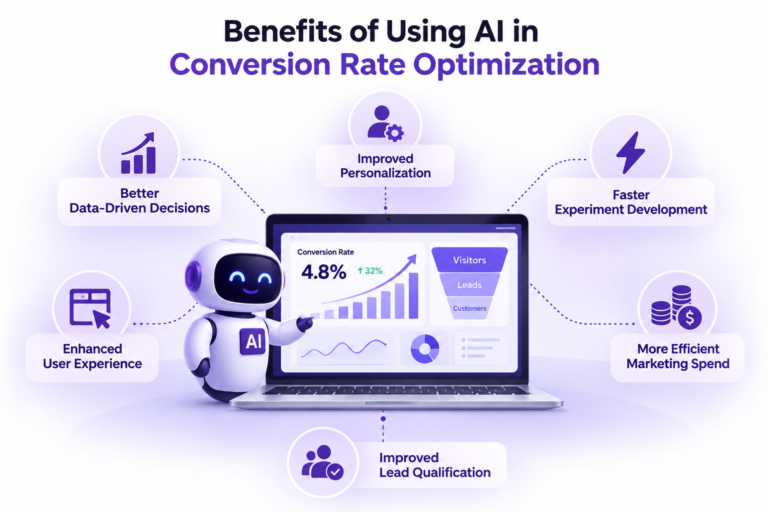
AI can make CRO more efficient when it is combined with a clear strategy, reliable data, and human judgment.
Better Data-Driven Decisions
AI can help identify patterns across large datasets and highlight opportunities that manual analysis might overlook. This enables marketers to investigate potential problems with greater focus.
Improved Personalization
Relevant content and recommendations can help visitors find products, services, and information that match their needs.
Faster Experiment Development
AI can assist with generating test ideas, creating page variations, and organizing experiments, reducing some of the manual work involved in optimization.
More Efficient Marketing Spend
Improving conversion rates can help businesses generate additional outcomes from existing traffic. This may improve campaign efficiency, although results depend on the quality of traffic, the offer, and the effectiveness of the changes.
Enhanced User Experience
By identifying confusing navigation, unnecessary form fields, and other friction points, AI-assisted CRO can help create smoother digital experiences.
Improved Lead Qualification
Predictive insights and conversational tools can help sales teams prioritize relevant inquiries and respond to potential customers more efficiently.
How to Implement AI in Your CRO Strategy in 2026
Businesses do not need to automate every part of their marketing process at once. A structured approach makes it easier to identify useful opportunities and evaluate results.
Step 1: Define Your Conversion Goals
Start by deciding what success means for your website.
Possible goals include purchases, qualified leads, consultation bookings, newsletter subscriptions, or completed registrations.
Choose a primary conversion metric and supporting metrics that reflect your business objectives.
Step 2: Audit Your Existing Website Performance
Review analytics data to understand current conversion rates, traffic sources, device performance, landing page engagement, and form completion rates.
Identify pages that receive meaningful traffic but generate fewer conversions than expected.
Check whether tracking is implemented correctly before relying on the reported data.
Step 3: Identify Conversion Barriers
Use analytics, user feedback, heatmaps, usability testing, and customer support questions to identify potential problems.
AI can help summarize large amounts of feedback or highlight recurring patterns, but the findings should be checked against real user behavior.
Step 4: Select Suitable AI Tools
Choose tools based on your specific CRO requirements.
Different platforms support different functions, such as analytics, experimentation, personalization, heatmaps, customer engagement, or content generation.
Consider integration requirements, privacy controls, cost, reporting quality, and the skills needed to operate each platform.
Step 5: Develop a Prioritized Testing Plan
Create hypotheses based on evidence rather than making random design changes.
For example: “Moving the consultation CTA above the fold may increase qualified inquiries because many visitors leave before reaching the current button.”
Prioritize experiments according to potential impact, confidence in the evidence, and implementation effort.
Step 6: Run Controlled Experiments
Test one clearly defined change or a carefully designed set of variations. Ensure that the experiment has suitable traffic, reliable measurement, and enough time to produce interpretable results.
Avoid making several unrelated changes simultaneously if you need to understand which change affected performance.
Step 7: Measure Business Outcomes
Look beyond the overall conversion rate. Depending on your business model, evaluate qualified leads, revenue per visitor, average order value, customer acquisition cost, refund rates, and completed purchases.
This helps ensure that optimization produces meaningful business improvements rather than simply increasing low-quality submissions.
Step 8: Improve and Repeat
CRO is an ongoing process. Use experiment results, customer feedback, and new behavioral insights to develop the next set of improvements.
Document what worked, what did not, and what remains uncertain. This creates a stronger foundation for future testing.
Best AI Tools for Conversion Rate Optimization
The right tools depend on your website, budget, data maturity, and optimization goals. The following platforms offer different capabilities that can support CRO workflows.
| Tool | Primary Use | How It Supports CRO |
|---|---|---|
| Google Analytics 4 | Website analytics | Tracks conversions, user journeys, and traffic behavior |
| Microsoft Clarity | Heatmaps and session recordings | Helps identify usability issues and interaction patterns |
| Hotjar | User behavior insights and feedback | Supports heatmaps, recordings, surveys, and user feedback |
| VWO | Experimentation and testing | Supports A/B testing and website experimentation |
| Optimizely | Digital experimentation | Helps teams test and evaluate digital experiences |
| ChatGPT | Content and hypothesis development | Helps generate test ideas, headlines, and landing page copy variations |
Features, integrations, pricing, and availability can change, so businesses should verify current product capabilities before selecting a platform.
No single AI tool can guarantee a higher conversion rate. The strongest results generally come from using appropriate tools within a well-measured optimization process.
Common Mistakes to Avoid When Using AI for CRO
Although AI offers valuable opportunities, implementing it without a clear strategy can create new problems.
Relying Entirely on AI Recommendations
AI may identify patterns or suggest improvements, but its recommendations can be incomplete or incorrect. Validate important decisions with reliable data and testing.
Ignoring Data Quality
Incorrect conversion tracking, duplicated events, missing sessions, and inconsistent analytics can lead to misleading conclusions.
Personalizing Without User Consent
Businesses should follow applicable privacy requirements, explain relevant data practices, and avoid collecting unnecessary personal information.
Running Too Many Tests at Once
Overlapping experiments can make it difficult to understand which changes influenced the results. Design experiments carefully and account for interactions between tests.
Optimizing for Clicks Instead of Business Results
A higher click-through rate does not always mean more revenue or better leads. Measure outcomes that align with your actual business goals.
Ignoring Human Judgment
AI can support research and analysis, but marketers still need to understand customer needs, brand positioning, business constraints, and ethical considerations.
The Future of AI and Conversion Rate Optimization
The role of AI in CRO is likely to continue evolving as analytics, experimentation, personalization, and automation technologies develop.
Several areas are especially relevant for businesses in 2026.
More Context-Aware Personalization
Digital experiences may increasingly adapt to the needs and intent of different visitor segments, while maintaining appropriate privacy safeguards.
Faster Experiment Workflows
AI may reduce the time needed to generate hypotheses, create variations, and interpret results. Reliable experimental design will remain essential.
Deeper Integration Between Marketing and Sales
Better connections between website behavior, CRM data, and sales outcomes can help businesses distinguish high-volume leads from leads that are more likely to become customers.
More Conversational Digital Experiences
AI assistants may help users navigate complex products and services, compare options, and access support during the buying journey.
Greater Focus on Privacy and Transparency
As businesses adopt more AI-powered tools, responsible data use, clear consent practices, security, and transparent communication will remain important.
The future of CRO will not simply be about using more AI. It will be about using AI where it creates measurable value for customers and businesses.
Frequently Asked Questions (FAQs)
How is AI transforming Conversion Rate Optimization in 2026?
AI helps businesses analyze user behavior, personalize website content, generate testing ideas, identify potential conversion barriers, and improve customer journeys. It supports data-driven decisions and can make optimization workflows more efficient.
Can AI increase website conversion rates?
AI can help identify and address issues that prevent visitors from converting. However, improvements depend on website quality, audience intent, traffic sources, offer relevance, and the effectiveness of tested changes. No tool guarantees a specific conversion increase.
What are the best AI tools for CRO?
Tools such as Google Analytics 4, Microsoft Clarity, Hotjar, VWO, Optimizely, and ChatGPT can support different CRO activities. The best choice depends on whether a business needs analytics, behavioral insights, experimentation, personalization, or content development.
How does AI improve landing page conversions?
AI can help generate headline variations, refine value propositions, identify potential usability problems, personalize content, and support landing page experiments. Businesses should test proposed changes to determine whether they improve meaningful conversions.
Is AI-powered CRO suitable for small businesses?
Yes. Small businesses can begin with accessible analytics tools, basic user behavior analysis, and AI-assisted content testing. Starting with one high-priority landing page or form can make the process manageable.
Conclusion
AI is transforming Conversion Rate Optimization by helping businesses analyze user behavior, personalize website experiences, develop experiments, improve landing pages, and identify barriers across the customer journey.
In 2026, businesses can use AI-assisted CRO to make better use of existing traffic and build more relevant digital experiences. However, technology alone cannot guarantee higher conversions. Reliable analytics, thoughtful experimentation, user-focused design, and human judgment remain essential.
For businesses that want to improve website performance, the best approach is to begin with clear conversion goals, identify the most important friction points, and test improvements using measurable outcomes.
Digitianera helps businesses strengthen their digital marketing strategies through SEO, website optimization, content development, and data-informed marketing practices. If you want to improve your website’s performance and turn more visitors into meaningful leads, connect with Digitianera to explore an optimization strategy aligned with your business goals.