- Written by: Kanika Chawla
- August 29, 2026
- Categories: Blog
- Tags: , keyword ranking report, monthly SEO report, organic traffic report, search performance report, SEO Analysis Report, SEO audit report, SEO KPIs, SEO metrics, SEO performance report, SEO report checklist, SEO report example, SEO report template, SEO reporting, SEO reporting tools, what to include in an SEO report
What to Put in SEO Report: Complete SEO Report Checklist
An SEO report helps businesses understand how their website is performing in search engines, what SEO work has been completed, and which areas need attention. A good report does more than show traffic and keyword positions. It connects SEO performance with business goals and explains what should happen next.
But what to put in SEO report depends on the website, industry, SEO objectives, and target audience. A local business may focus on rankings, calls, and enquiries, while an e-commerce website may focus on product visibility, organic revenue, transactions, and conversions.
A professional SEO report should make the data easy to understand. It should explain what changed, why it changed, what actions were taken, and which improvements should be prioritized next.
In this guide, we will explain what to put in SEO report, the most important SEO metrics to track, how to structure a monthly report, common reporting mistakes, and how to create an actionable SEO report.
What Is an SEO Report?
Before understanding what to put in SEO report, it is important to understand its purpose.
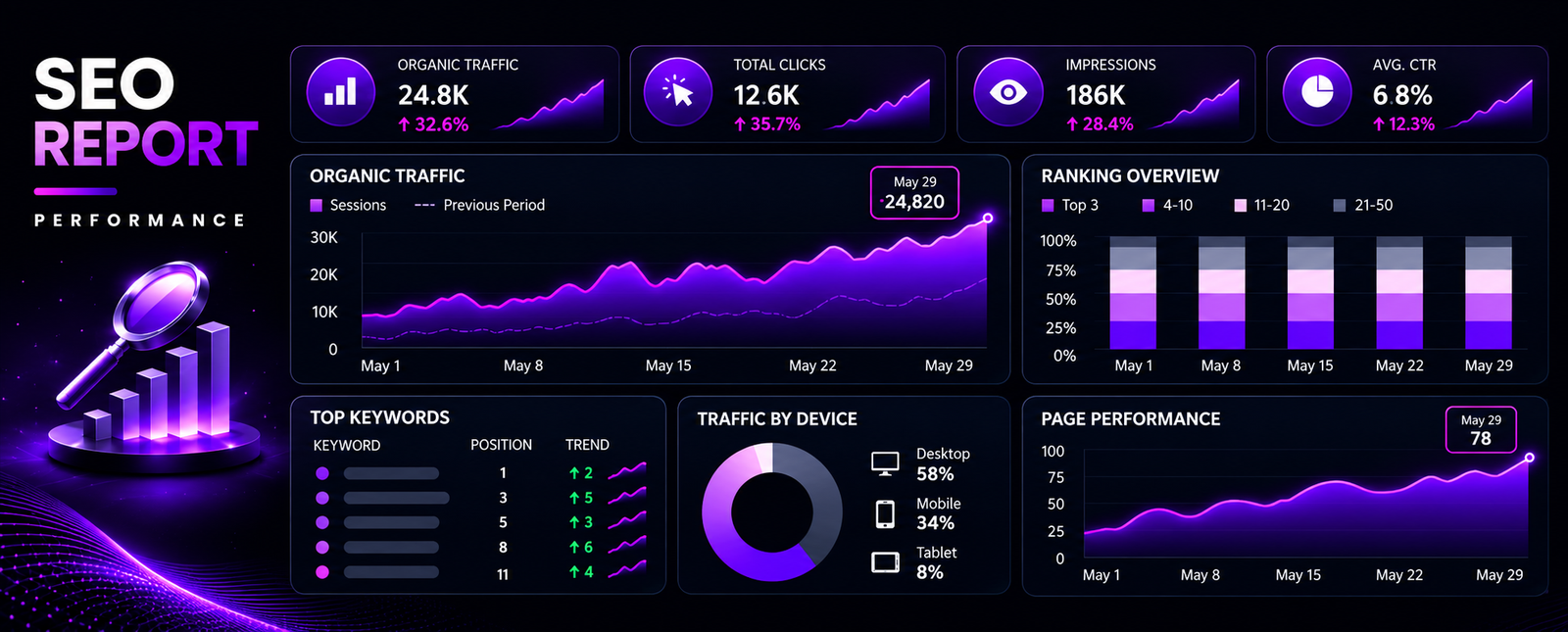
An SEO report is a summary of a website’s search performance and SEO activities over a specific period. It may include organic traffic, keyword rankings, search impressions, clicks, CTR, technical SEO, content performance, backlinks, conversions, and other campaign-specific information.
Data can be collected from platforms such as Google Search Console, Google Analytics, keyword tracking tools, backlink tools, and technical SEO platforms.
However, data alone does not make an SEO report useful.
A good report should answer five questions:
- What happened?
- What changed?
- Why did it change?
- What work was completed?
- What should happen next?
For example, if organic traffic increases by 20%, the report should identify which pages contributed to that growth and whether the increase resulted in more leads, sales, or other valuable actions.
For search performance data, you can reference Google Search Console.
What to Put in an SEO Report?

If you are deciding what to put in SEO report, begin with the goals of the SEO campaign.
A well-structured report can include:
- Executive summary
- SEO goals and KPIs
- Organic traffic
- Search impressions and clicks
- CTR
- Keyword rankings
- Search visibility
- Top-performing pages
- Technical SEO
- On-page SEO
- Content performance
- Internal linking
- Backlinks
- Competitor analysis
- Local SEO
- E-commerce performance
- Conversions
- Completed SEO activities
- Issues and recommendations
- Next month’s plan
Not every website needs every section. Choose the metrics that are relevant to the business.
SEO Report Sections at a Glance
| SEO Report Section | What to Include | Why It Matters |
|---|---|---|
| Executive Summary | Key results and changes | Quick campaign overview |
| Goals & KPIs | Targets and objectives | Connects SEO with business goals |
| Organic Traffic | Users, sessions and trends | Measures search traffic |
| Search Performance | Impressions, clicks and CTR | Measures visibility |
| Keyword Rankings | Current and previous positions | Tracks ranking progress |
| Technical SEO | Indexing, crawling and errors | Identifies technical problems |
| Content | New and updated pages | Measures content performance |
| Internal Linking | Important connected pages | Improves site structure |
| Backlinks | New and lost links | Tracks authority |
| Conversions | Leads, sales and enquiries | Measures business impact |
| Recommendations | Priority actions | Creates a roadmap |
| Next Month | Planned SEO activities | Defines future work |
1. Executive Summary
The executive summary gives readers a quick understanding of campaign performance.
When considering what to put in SEO report, include the most important developments here rather than making the reader search through multiple sections.
Include:
- Organic traffic changes
- Major ranking improvements
- Ranking declines
- Search visibility
- Technical improvements
- Content work
- Leads or conversions
- Major issues
- Next month’s priorities
For example:
Organic search visibility improved during the reporting period, with several priority pages gaining rankings for relevant non-branded searches. Content and technical optimizations were completed, while the next phase will focus on internal linking, content improvements, and conversion opportunities.
The summary should explain the meaning behind the numbers instead of simply listing statistics.
2. SEO Goals and KPIs
Another important part of what to put in SEO report is the campaign’s goals and key performance indicators.
Common SEO goals include:
- Increasing organic traffic
- Improving keyword rankings
- Generating qualified leads
- Increasing organic sales
- Improving local visibility
- Increasing non-branded traffic
- Building topical authority
- Improving conversions
KPIs should be selected according to the business objective.
For example, a service business may focus on leads and enquiries, while an online store may prioritize transactions, organic revenue, and conversion rate.
A strong SEO Strategy can help determine which KPIs should be tracked and how SEO activities should be prioritized.
3. Organic Traffic
Organic traffic is one of the most important metrics to include.
When determining what to put in SEO report, include traffic data that helps explain how many visitors are coming from unpaid search results.
Useful metrics include:
- Organic users
- Organic sessions
- New users
- Engaged sessions
- Landing pages
- Traffic trends
Compare the current period with a relevant previous period, such as:
- Month over month
- Year over year
- Previous campaign period
However, traffic changes should always be interpreted carefully.
Seasonality, promotions, search demand, algorithm changes, and other marketing campaigns can influence organic traffic.
For businesses targeting smaller companies, SEO for SMBs can also be used as a relevant internal resource when discussing campaign goals and measurement.
4. Search Impressions, Clicks and CTR
Google Search Console provides valuable information about how pages perform in Google Search.
When deciding what to put in SEO report, consider these important metrics.
Impressions
Impressions show how often a website appeared in search results.
Increasing impressions can indicate growing search visibility.
Clicks
Click-through rate shows the percentage of impressions that resulted in clicks.
A page with high impressions but low CTR may need improvements to its title, description, relevance, or search intent.
Average Position
Average position provides an indication of how pages performed for tracked search queries.
For additional information about Google’s search systems, you can refer to Google Search Central.
5. Keyword Rankings
Keyword rankings remain an important component of what to put in SEO report, especially when specific keywords are part of campaign objectives.
Include:
- Target keyword
- Previous position
- Current position
- Ranking change
- Search intent
- Landing page
- Business relevance
Avoid adding hundreds of keywords without context. Focus on keywords that have strong relevance, search intent, and business value.
Relevant SEO tools can help monitor keyword positions and identify ranking opportunities.
6. Search Visibility
Ranking positions alone do not provide the complete picture.
When reviewing what to put in SEO report, consider including:
- Total ranking keywords
- New ranking keywords
- Top 10 keywords
- Top 20 keywords
- Keywords entering the top 100
- Branded visibility
- Non-branded visibility
- Important page visibility
Non-branded visibility is particularly useful because it shows whether the website is reaching people who are not already searching for the brand.
7. Top-Performing Pages
When reviewing what to put in SEO report, do not focus only on keywords.
Analyze the performance of individual pages as well.
Useful information includes:
- URL
- Organic traffic
- Impressions
- Clicks
- CTR
- Ranking keywords
- Conversions
- Performance changes
A page may receive significant organic traffic but generate very few enquiries.
This could indicate an opportunity to improve:
- Internal links
- Calls to action
- Landing-page experience
- Content relevance
- Conversion elements
8. Technical SEO Performance
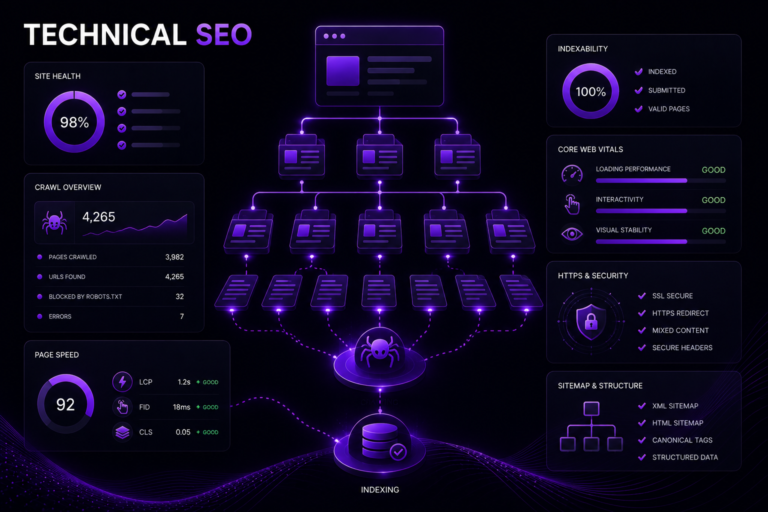
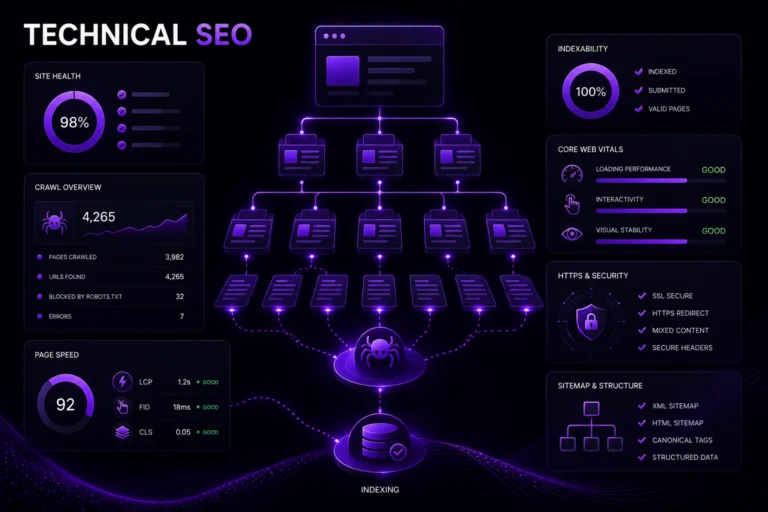
Technical SEO is another major section when deciding what to put in SEO report.
Depending on the website, review:
- Crawlability
- Indexing
- Broken links
- Redirects
- Canonical URLs
- XML sitemap
- Robots.txt
- Mobile usability
- Page speed
- Core Web Vitals
- Duplicate content
- HTTPS
- Structured data
Do not simply say that technical SEO was completed.
Explain what problems were identified and what actions were taken.
For example:
Important pages were reviewed for indexing and crawlability. Technical issues were identified and corrected, while the sitemap and internal linking structure were also reviewed.
If technical changes require development work, Web Development can be linked as a relevant internal resource.
9. On-Page SEO
On-page SEO should also be documented in the report.
This may include:
- Title tag optimization
- Meta descriptions
- Heading improvements
- Search intent alignment
- Content optimization
- Keyword targeting
- Image alt text
- URL optimization
- Internal linking
Instead of listing every small change, summarize the overall work.
For example:
Priority landing pages were optimized to improve titles, headings, content relevance, metadata, and internal linking.
10. Content Performance
Content performance is an important part of what to put in SEO report, particularly for content-driven SEO campaigns.
Include:
- New content published
- Existing content updated
- Organic traffic by article
- Ranking improvements
- Search impressions
- Clicks
- Conversions
- URL optimization
- Content gaps
- Pages requiring optimization
Look for pages that:
- Have high impressions but low CTR
- Rank between positions 11 and 20
- Receive traffic but few conversions
- Contain outdated information
- Have weak internal linking
Updating an existing article can sometimes provide more value than continually publishing new content.
11. Internal Linking Performance
Internal linking should be included in what to put in SEO report when internal-link optimization is part of the campaign.
You can report:
- New contextual links
- Important pages connected
- Orphan pages
- Anchor-text improvements
- Topic clusters strengthened
Relevant pages can be connected through natural anchors such as Local SEO, E-Commerce SEO, SEO for SMBs, and CRO.
Internal links should always provide value to the reader. Avoid adding links only for the purpose of increasing the number of internal links.
12. Backlink Profile
Backlinks are another important element of what to put in SEO report, especially when link building is part of the campaign.
Useful metrics include:
- New referring domains
- New backlinks
- Lost backlinks
- Relevant referring websites
- Domain quality
- Anchor-text distribution
- Important link opportunities
- Do not focus only on backlink quantity.
A smaller number of relevant, trustworthy links may be more valuable than a large number of low-quality links.
The report should explain the quality and relevance of the backlink profile.
13. Competitor Analysis
Competitor analysis provides useful context when evaluating what to put in SEO report.
Depending on the campaign, compare:
- Keyword visibility
- Ranking keywords
- Content coverage
- Backlink profiles
- Content gaps
- Important landing pages
- Search intent
- The goal is not simply to show which competitor has more backlinks or rankings.
- Instead, identify opportunities.
For example:
Competitors are covering several informational topics that are currently missing from the website. These gaps can provide opportunities for new content and stronger topical coverage.
The Best SEO Services resource can be linked here if it provides relevant additional information.
14. Local SEO Performance
For businesses that depend on customers from specific locations, local search performance can be an important reporting area.
When deciding what to put in SEO report, consider:
- Local keyword rankings
- Google Business Profile activity
- Calls
- Website visits
- Reviews
- Local landing-page performance
- Citation activity
Overall website traffic may not accurately represent local SEO performance.
A local business can gain visibility for location-based searches even when overall traffic changes only slightly.
A relevant Local SEO article can be internally linked from this section.
15. E-Commerce SEO Performance
E-commerce websites require additional metrics.
When deciding what to put in SEO report for an online store, include:
- Organic product traffic
- Category-page performance
- Product-page rankings
- Organic revenue
- Transactions
- Conversion rate
- Product impressions
- Non-branded product searches
- Organic landing pages
Product pages and category pages often have different search intents, so analyze them separately.
Relevant E-Commerce SEO content can be internally linked here to provide additional information.
16. Conversions and Leads
Conversions are one of the most valuable parts of what to put in SEO report for a business-focused campaign.
Traffic and rankings are useful, but businesses ultimately need measurable outcomes.
Depending on the website, track:
- Leads
- Form submissions
- Phone calls
- Purchases
- Consultation requests
- Sign-ups
- Conversion rate
- Revenue
For example:
Organic traffic increased by 18%, while organic leads increased by 31%. This suggests that the campaign is attracting more relevant visitors.
If high-traffic pages generate few conversions, CRO can help improve landing pages, forms, calls to action, and user journeys.
17. Work Completed During the Reporting Period
A client should clearly understand what SEO work was completed.
This is an important part of what to put in SEO report because clients need to understand the activities behind performance changes.
Possible activities include:
Technical SEO
- Indexing fixes
- Sitemap improvements
- Broken-link fixes
- Performance improvements
On-Page SEO
- Title optimization
- Meta description updates
- Heading improvements
- Internal linking
Content
- New articles
- Content updates
- Content expansion
- Topic research
Authority Building
- Backlink acquisition
- Outreach
- Digital PR
Group activities by category so the work is easy to understand.
18. Issues Identified
An honest SEO report should also explain problems.
When deciding what to put in SEO report, include issues that could affect future performance.
Examples include:
- Ranking declines
- Organic traffic decreases
- Indexing problems
- Broken links
- Slow pages
- Duplicate content
- Missing metadata
- Content gaps
- Lost backlinks
- Low-converting pages
Use a simple structure:
Problem → Impact → Recommended Action
For example:
Problem: Important pages have high impressions but low clicks.
Impact: The website is gaining visibility without receiving enough traffic.
Action: Review titles, descriptions, search intent, and content relevance.
19. SEO Recommendations
Recommendations turn data into an actionable plan.
When considering what to put in SEO report, include clear next steps rather than ending with statistics.
Possible recommendations include:
- Optimize pages ranking between positions 11 and 20.
- Improve pages with high impressions but low CTR.
- Update outdated content.
- Strengthen internal linking.
- Fix technical indexing issues.
- Create content around identified gaps.
- Improve important service pages.
- Optimize high-traffic pages for conversions.
Prioritize recommendations into high, medium, and low priority.
This makes it easier for businesses to understand what should be addressed first.
20. Next Month’s SEO Plan
The next-month plan is an important element of what to put in SEO report.
A report should explain both past performance and upcoming activities.
Include:
Technical SEO
Technical problems that will be addressed.
Content
Articles or pages that will be created or updated.
On-Page SEO
Pages that will receive optimization.
Internal Linking
Topic clusters that will be strengthened.
Authority Building
Planned link-building activities.
Conversion Optimization
Landing pages or conversion elements that need improvement.
This creates a clear roadmap for the next reporting period.
What Makes a Good SEO Report?
Clear
Use simple language and explain technical terms.
Relevant
Focus on metrics that matter to the campaign.
Data-Driven
Use reliable data sources.
Honest
Show both improvements and challenges.
Actionable
Provide clear recommendations.
Consistent
Use a similar format every month.
Business-Focused
Connect SEO activities with traffic, leads, sales, and business goals.
The best SEO report is not necessarily the longest. It is the one that helps the reader understand performance and make better decisions.
Common SEO Reporting Mistakes
Reporting Vanity Metrics
High traffic does not automatically mean business growth.
Showing Rankings Without Context
A ranking position alone does not show whether a keyword is valuable.
Overloading the Report
Too many metrics can make the report difficult to understand.
Ignoring Conversions
SEO should be connected to meaningful business outcomes.
Hiding Problems
Ranking declines and technical issues should be explained honestly.
No Action Plan
Clients should know what will happen next.
Inconsistent Reporting
Changing the report structure every month makes trends harder to compare.
SEO Report Template for Monthly Reporting
If you need an SEO report template, use this structure:
- Executive Summary
- Goals & KPIs
- Organic Performance
- Keyword Performance
- Search Visibility
- Technical SEO
- On-Page SEO
- Content Performance
- Internal Linking
- Backlinks
- Competitor Insights
- Local SEO
- Conversions
- Completed Work
- Issues Identified
- Recommendations
- Next Month’s Plan
This structure provides a consistent framework for monthly SEO reporting.
How to Improve Your SEO Reporting Process
Knowing what to put in SEO report is only the first step.
Start by defining the business objectives and selecting KPIs that match them. Collect data from reliable sources and compare it with an appropriate previous period.
Next, investigate significant changes rather than simply reporting them. Document the work completed, identify problems, and turn the findings into prioritized recommendations.
The right SEO tools can help collect keyword, technical, backlink, and performance data throughout this process.
The most important step is to interpret the data and explain what it means for the business.
How Digitianera Can Help With SEO Reporting
At Digitianera, we believe SEO reporting should do more than present traffic graphs and keyword positions.
A useful report should explain:
- What happened
- What changed
- Why it changed
- What work was completedWhat work was completed
- What problems were identified
- What opportunities exist
- What should happen next
Our SEO reporting approach can include:
- Organic traffic analysis
- Keyword performance
- Search visibility
- Technical SEO progress
- Content performance
- Internal linking
- Backlink analysis
- Competitor insights
- Local search performance
- E-commerce performance
- Conversion tracking
- Completed SEO activities
- Priority recommendations
- Future SEO planning
The reporting approach can be adapted according to the business. A small business may need to focus on leads and local visibility, while an e-commerce website may prioritize organic revenue and product performance.
Frequently Asked Questions (FAQs)
What to put in SEO report for a small business?
For a small business, include organic traffic, important keyword rankings, local visibility, leads, calls, landing-page performance, technical SEO, content performance, and conversions. Focus on metrics that directly relate to business goals.
What should be included in an SEO report?
A professional report can include an executive summary, goals, organic traffic, search performance, keyword rankings, technical SEO, content, backlinks, internal links, competitor insights, conversions, completed work, recommendations, and future activities.
How often should an SEO report be created?
Monthly reporting is common because it provides enough time for meaningful trends to develop while allowing businesses to monitor progress regularly.
Should keyword rankings be included?
Yes. Keyword rankings can demonstrate search visibility, but they should be evaluated alongside traffic, conversions, search intent, and business value.
Should backlinks be included in an SEO report?
If link building is part of the campaign, backlinks should be included. Focus on relevant referring domains, important backlinks, lost links, and quality rather than only the total number.
Conclusion
Understanding what to put in SEO report is important, but knowing how to interpret the information is even more valuable.
A strong SEO report should connect SEO activities with website performance and business outcomes. Organic traffic, keyword rankings, impressions, clicks, technical SEO, content performance, backlinks, internal links, conversions, and search visibility can all provide useful insights when presented in the right context.
Avoid filling reports with unnecessary metrics simply because an SEO platform provides them. Focus instead on information that helps explain performance, identify problems, uncover opportunities, and determine the next steps.
At Digitianera, we focus on making SEO reporting clear, practical, and connected to business goals. If you want to understand your website’s organic performance, identify SEO opportunities, improve visibility, or build a more effective reporting process, our team can help.
Ready to Improve Your SEO Performance?
Contact Digitianera today to discuss your website, SEO goals, and reporting requirements. Let’s build an SEO reporting process focused on measurable growth.
Contact Us → Digitianera