

- Written by: Naveen Singh
- June 8, 2026
- Categories: Blog, SEO Strategy
- Tags: , Best Digital Marketing Services in India, Best Soical Media Services, Digitianera, Social media Marketing Plan?, Social media strategy
How to Build a Winning Social Media Marketing Plan?
According to marketing professionals, random posting consistently fails because it confuses the algorithm the invisible computer rules that decide who sees your content. Treating a business account like a personal diary destroys your organic reach, which is the number of people who see your posts for free. A sustainable social presence rests on three vital pillars instead: a clear message, a genuine connection, and absolute consistency.
Building well-crafted social media marketing plans is the cure for that “what now?” feeling. Instead of throwing random ideas at the wall to see what sticks, you build a cohesive system that works while you sleep. A professional social media strategy ensures that every minute you spend online actually moves your business forward.
Escaping the cycle of random posting requires following a proven, five-phase roadmap for total social media clarity. Soon, you will master setting realistic goals, defining your audience, crafting your content, scheduling your posts, and reviewing your success. By following these straightforward steps, you will finally transform your overwhelming digital chores into a powerful engine for your business.
How to Spot the Holes in Your Current Strategy with a 30-Minute Audit
Building effective social media marketing plans starts with a hard look at what you already have, rather than rushing to create a dozen new updates. Before you write another caption, you need to identify your “profile leaks”—those frustrating friction points, like a confusing bio or broken website link, that cause curious visitors to abandon your page. Learning how to conduct a social media audit stops these leaks by giving your digital storefront a quick, vital health check.
You don’t need complicated software to review your existing assets; you just need thirty minutes and this straightforward five-step checklist:
- Bio/Profile consistency: Does your page clearly explain what you offer?
- Posting frequency: Are there massive, month-long gaps in your timeline?
- Top 3 performing posts: Which recent updates started actual conversations?
- Bottom 3 performing posts: What topics heard nothing but crickets?
- Link click verification: Tap your own profile links to ensure they actually work.
Plugging these holes ensures that when new people discover your business, they have a seamless path from your social page straight to your cash register. With a polished profile ready for visitors, you might feel tempted to chase massive, overnight exposure. However, preparing your account is just the foundation. Setting specific targets that actually drive revenue is the crucial next step.
Why ‘Going Viral’ Isn’t a Goal and How to Set SMART Targets That Actually Drive Revenue
We’ve all seen a local business post a meme that gets thousands of likes, yet their cash register stays completely quiet. This happens when you focus on “Vanity Metrics”—numbers like follower counts that look impressive but don’t pay the rent—instead of “Value Metrics,” like website clicks or actual sales. Chasing viral fame is a trap because attention only matters if it brings you closer to a tangible business result.
Turning that attention into revenue requires a shift in how you plan your strategy. Instead of wishing for more followers, you need a framework for setting smart goals for social media. This means creating targets that are Specific, Measurable, Achievable, Relevant, and Time-bound (SMART). Think of it like mapping a road trip: you wouldn’t drive aimlessly hoping to find a beach; you set a precise destination and arrival time.
Let’s look at how this works for a neighborhood coffee shop running promotional social media campaigns. A vague goal is simply “get more people to buy our new winter latte.” A SMART goal translates that ambition into: “Sell fifty winter lattes this week by posting a daily coupon code.” Notice how the second version gives you a clear finish line and tells you exactly what to post.
Defining exactly what you want your digital storefront to achieve ensures your time online is actually well spent. However, even the most precise revenue targets will fail if you are talking to the wrong crowd. Understanding who sits on the other side of the screen requires moving beyond demographics to build target personas that feel like real people.
Beyond Demographics: How to Build Target Personas That Feel Like Real People
Ask many business owners who their ideal customer is, and they will enthusiastically reply, “Everyone!” While it sounds great in theory, trying to talk to everybody on the internet usually means you end up connecting with no one. A successful social media strategy requires you to narrow your focus by creating a “buyer persona,” which is simply a detailed, fictional character who represents your perfect, real-world customer. Instead of shouting into a faceless crowd, you are writing every post for one specific person who genuinely needs what you sell.
Figuring out who this person is means looking past basic facts like their age or zip code to understand their “pain points”—the specific, everyday frustrations they are trying to solve. Think about a local fitness coach trying to sell online training programs. If their audience’s biggest pain point is a total lack of free time, posting two-hour daily workout routines will completely alienate them. When you understand exactly what frustrates your ideal customer, you can position your business as the exact, helpful solution they have been searching for online.
This is the secret to defining target audience personas that actually work: give them a name and a daily routine. Rather than targeting a robotic “Segment A: females 30-45,” you are talking to “Busy Sarah,” a working mom who only has twenty minutes to exercise and scrolls Instagram during her morning train commute. Knowing this level of detail tells you exactly where your audience spends their time online, meaning you stop wasting effort on platforms they never even visit.
Once you know exactly who Sarah is and what problems she needs solved, staring at a blank screen becomes a thing of the past. You no longer have to guess what she wants to hear; you just have to answer her specific questions. Logically organizing those answers ensures a steady stream of valuable content.
The Four-Bucket Method for Never Running Out of Post Ideas Again
Knowing exactly who you want to talk to is only the first step; you still need a system to feed them engaging posts without losing your mind. This is where developing unique social media content pillars comes in. Think of these pillars as four distinct buckets of topics you regularly dip into so you never run out of ideas.
By sorting your thoughts into these specific categories, you can easily map out a full month’s worth of posts in a single afternoon sitting. Here is the Four-Bucket Framework you can start using today:
- Educational (How-to): Answer your customer’s common questions, like a local bakery sharing the secret to keeping bread fresh at home.
- Inspirational (Stories): Share customer successes or your own business journey to build a genuine, human connection.
- Entertaining (Behind-the-scenes): Show the messy, real-life process of what you do on a daily basis.
- Promotional (The ‘Ask’): Directly tell your audience what you sell and exactly how they can buy it.
Filling these buckets is only half the battle; knowing how to balance them is what separates amateurs from professionals. The secret to keeping followers engaged without feeling like a pushy car salesperson is the 80/20 rule. This simply means 80% of your posts should offer free value—focusing entirely on the educational, inspirational, and entertaining buckets—while only 20% should directly ask for a sale. The most effective social media marketing plans rely on this exact ratio because people log online to connect and learn, not to read constant commercials.
Mastering this balanced approach immediately transforms social media from a stressful daily chore into a highly organized system. When you focus on delivering genuine value first, your audience naturally wants to hear what you have to sell when the time comes. Delivering this message effectively requires a consistent brand voice that sounds human rather than corporate.
Creating a Consistent Brand Voice That Doesn’t Sound Like a Corporate Robot
When a company’s post sounds as stiff as a legal document, it immediately alienates readers. People buy from people, meaning your digital storefront needs to sound undeniably human. The secret is understanding the difference between your brand voice (your core personality) and your brand tone (your current mood). Your overall voice never changes, but your tone adapts depending on whether you are celebrating a customer’s success or apologizing for a shipping delay.
To avoid alienating followers with robotic corporate-speak, try the “Three Adjective” rule. Pick three words describing exactly how your business should sound, like “warm, witty, and helpful” for a local bookstore. Before publishing a caption or replying to a comment, read it out loud to see if it hits those specific marks. This simple filter is the easiest way to start building a consistent brand voice online. It guarantees that no matter who on your team hits publish, the message always sounds like it came from the exact same person.
The most effective social media marketing plans rely on this consistency because familiar personalities naturally build trust. When your followers know what kind of human interaction to expect, they are much more likely to engage regularly. Amplifying these conversational posts requires a strategic mix of organic reach and paid advertisements.
Organic Reach vs. Paid Ads: When to Post for Free and When to Open Your Wallet
Publishing a brilliant update only to watch it reach a tiny fraction of your followers is deeply frustrating. That experience is the work of the Algorithm, the automated gatekeeper deciding which posts appear in a user’s feed. Social platforms use these invisible bouncers to prioritize content that sparks lively conversations. When you post for free, you rely on organic reach, hoping the algorithm naturally serves your message to the public. Because platforms are crowded, relying solely on free views is slow, meaning great posts sometimes need a financial push.
Deciding exactly when to use that financial push forms the foundation of a smart organic reach vs paid advertising strategy. The most common mistake beginners make is spending money to rescue a post that nobody cared about in the first place. Instead, you should always follow the Golden Rule of ad spend: only pay to promote content that is already performing well on its own. Think of your advertising budget like lighter fluid; pouring it on a damp log will not start a fire, but adding it to a glowing ember creates a blaze.
Putting real money behind those glowing embers introduces the difference between a quick “boost” and complex social media campaigns. Boosting means clicking a button directly on your profile to put a few dollars behind an existing post, turning it into a digital megaphone that amplifies a proven winner. This is much simpler than building full-scale advertisements from scratch behind the scenes. If your local bakery posts a video of a fresh croissant that earns twice as many comments as usual, a quick boost is the safest way to attract new customers.
A healthy digital storefront relies on a comfortable mix of these two methods to protect both your budget and your peace of mind. You never need to pay for every single interaction, nor should you stress when a free post quietly fades away in the feed. By pairing authentic, everyday updates with a smart promotional budget for your top hits, your message will naturally spread. Organizing this workflow into a reliable content calendar maintains momentum while giving you your weekends back.
How to Build a Content Calendar That Gives You Your Weekends Back
Waking up and wondering what to publish every single morning is a guaranteed recipe for burnout. The secret to escaping this daily scramble is a productivity technique called content batching. Instead of interrupting your actual job every afternoon to write a single update, you block out two uninterrupted hours once a week to write and schedule everything at once. This simple shift treats your social media marketing plans like meal prep, keeping your message consistent while finally giving you your evenings and weekends back.
To make this workflow successful, you need a basic roadmap so you aren’t staring blankly at a screen during those two hours. You do not need expensive software; a free spreadsheet works perfectly as a social media content calendar template. By assigning your established content pillars to specific days, you build a reliable rhythm for your audience. Try this proven weekly structure to get started:
- Monday (Insight): Share a surprising fact or observation about your industry.
- Tuesday (Tip): Offer a quick, highly actionable piece of advice.
- Wednesday (Personal/Behind-the-scenes): Show a messy, authentic glimpse of your workspace.
- Thursday (Engagement Question): Ask your followers a relatable, easy-to-answer question.
- Friday (Promotion/Sale): Direct people straight to your cash register or booking link.
Sticking to this predictable grid layout means you only have to fill in the blanks each week, completely eliminating the stress of starting from scratch. Once your calendar is humming along and your posts are publishing automatically, you will start seeing regular interactions. Separating ‘vanity metrics’ from real growth reveals exactly how these regular interactions help your business.
Measuring What Matters: How to Separate ‘Vanity Metrics’ from Real Growth
Getting a hundred likes on a post feels great, but if those likes do not pay the rent, they are just “vanity metrics.” To see if your efforts are actually working, you must begin identifying key performance indicators for growth, or KPIs for short. Think of a KPI as a digital scoreboard tracking the exact numbers tied to your earlier SMART goals. Instead of blindly hoping for the best, these specific metrics tell you exactly what moves the needle for your business.
When opening your profile’s “Insights” tab, focus first on two foundational numbers: Reach and Engagement Rate. Reach is your digital foot traffic, representing the total number of unique people who scrolled past your post. Because window shoppers rarely guarantee sales, your Engagement Rate is much more important. This critical metric calculates the percentage of people who saw your content and actually stopped to interact by liking, saving, or commenting.
True business growth happens when those engaged followers leave the app to visit your website. You track this movement using your Click-Through Rate (CTR), which counts how many people clicked the link in your bio or post. A healthy CTR means your audience is intrigued enough to step through your digital front door. Once they arrive, you measure Conversion, which simply tracks how many of those curious visitors actually made a purchase or booked an appointment.
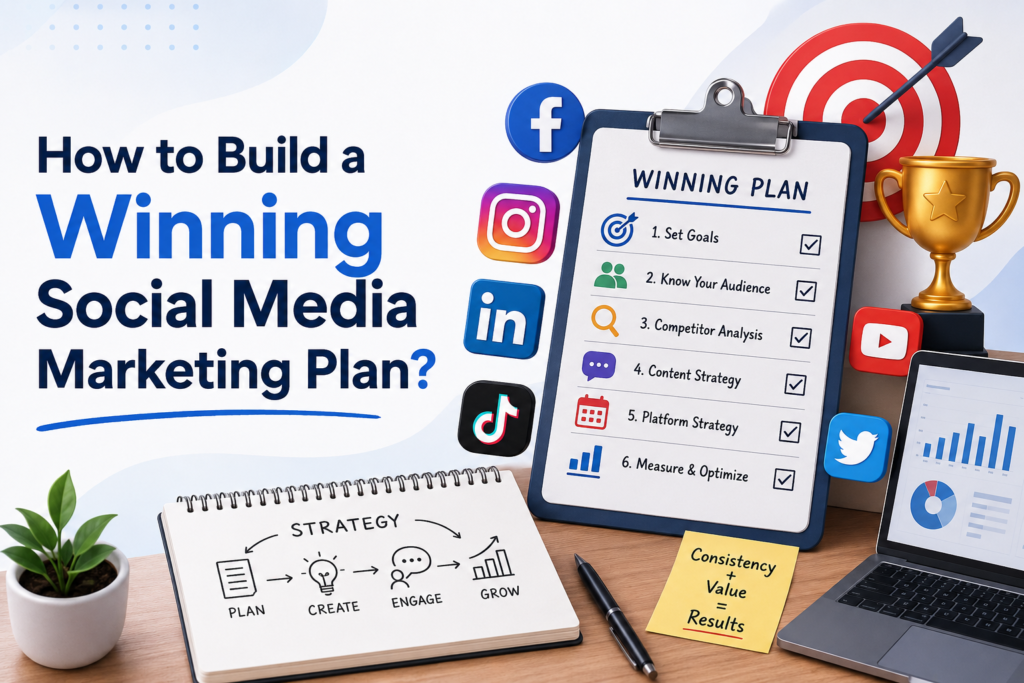
Reviewing these four numbers monthly lets you adjust your overall social media strategy using hard facts rather than guesswork. If engagement is high but clicks are low, you immediately know you need to ask people to visit your website more clearly. Different customer types require tailored approaches; B2B and B2C models require distinctly different playbooks to maximize this data.
B2B vs. B2C Social Tactics: Choosing the Right Playbook for Your Business Model
Selling software to a manager requires a completely different conversation than selling a latte to a student. When building your social media marketing plans, you must match the platform to your customer’s mindset. Think of Instagram as the digital coffee shop: people are there to relax and discover fun items, making it perfect for Business-to-Consumer (B2C) companies. Conversely, LinkedIn is the digital office. Professionals log in looking to network and solve workplace problems, making it the ideal environment for Business-to-Business (B2B) conversations.
Because these environments feel distinct, your b2b vs b2c social media tactics must adapt accordingly. A B2C bakery should lean into visuals and immediate desire, like a quick video of a warm cookie pulling apart. The tone is casual, and the buying decision happens instantly. However, if you are a B2B freelance designer pitching local agencies, your approach shifts from impulse to education. Your content must demonstrate expertise, perhaps by sharing exactly how your branding project increased a previous client’s sales.
The most significant difference you will experience between these models is the speed of the checkout line. B2C purchases often happen in minutes, while B2B social selling requires building trust with decision-makers over several weeks. You are not just asking someone to buy a pastry; you are asking them to trust you with a corporate budget. Managing these distinct relationships across platforms effortlessly requires a stack of low-cost social media management tools.
Choosing Your Toolkit: Social Media Management Tools That Don’t Require a Degree
Staring at your brand-new content calendar is a great feeling, but the thought of manually logging in to post every single day can quickly drain that excitement. You do not need to be glued to your phone to execute a strong social media strategy. Instead, the secret to staying consistent without burning out is building a low-cost tool stack. Think of these apps as your digital assistants—they work in the background, allowing you to automate your posting schedule to save 5+ hours a week.
Finding the best social media management tools for small business does not mean buying complex, expensive software. To get started, you only need three essentials to handle the heavy lifting. Here is your budget-friendly ‘Starter Pack’:
- Canva (Design for non-designers): This platform offers thousands of pre-made design templates, allowing you to access high-quality design assets without professional training.
- Buffer or Hootsuite (Scheduling): A scheduler acts like a timer; you upload a week’s worth of posts on Monday, and it automatically publishes them later.
- AnswerThePublic (Idea generation): Type in your industry, and this tool shows you exactly what questions people are actively searching for online so you always know what to say.
Once these systems are running smoothly, your digital storefront will stay active even when you are entirely off the clock helping customers. Ensuring these fresh, automated posts stand out in a crowded feed requires ethical competitive analysis.
Keeping Your Friends Close: A Framework for Ethical Competitive Analysis
Scrolling through a rival’s feed often triggers self-doubt, but studying their content is actually vital for successful social media marketing plans. Instead of viewing this as “stealing,” think of it as benchmarking—observing average industry performance to set realistic goals. If local bakeries average fifty likes on a pastry photo, you instantly know the baseline. This context prevents frustration if your own post does not immediately go viral, giving you a sane way to measure success.
Once you understand this baseline, you can easily spot what your competitors are ignoring. This introduces Content Gap Analysis, a strategy of asking, “What customer problems is no one else solving?” If every local fitness coach posts intense heavy-lifting workouts, but nobody shares beginner-friendly morning stretches, you have found your gap. Filling this specific void makes your business instantly valuable because you provide answers that your audience cannot find elsewhere.
Building a reliable social media competitive analysis framework guarantees you stand out rather than blend in. You are not copying your neighbors; you are learning the neighborhood rules so you can paint your digital storefront a totally unique color. Smart budget allocation safely funds this distinct strategy without emptying your wallet.
Where Every Dollar Goes: Simple Strategies for Allocating Your Social Media Budget
Many beginners assume profiles are entirely free, but effective social media budget allocation strategies involve more than just running ads. While organic posts skip the credit card, they demand your most valuable resource: time. Think of organic social media like a backyard garden; the dirt is free, but you still have to spend hours watering the seeds. Acknowledging this trade-off helps you accurately estimate your true business costs before you ever pay for a digital promotion.
Starting with a zero-dollar budget simply means shifting your currency from cash to sweat equity. Your initial expenses might just be a free graphic design app or a low-cost scheduling tool that automatically publishes posts while you sleep. Keeping software costs minimal builds a scalable routine that naturally grows alongside your revenue. Once those free organic efforts attract steady customers through the door, you can confidently invest real cash to amplify the messages that are already working.
When you are finally ready to fund social media campaigns, the “70/20/10 rule” keeps your finances incredibly safe. This framework dictates that seventy percent of your budget goes to proven content that reliably drives sales, like promoting a popular bakery item. Twenty percent funds safe expansions, like targeting a neighboring town. The final ten percent is reserved for wild experiments, like trying a brand-new video format. This structure prevents you from wasting money on unproven guesses.
Sticking to this disciplined strategy ensures your marketing acts as a predictable growth engine rather than a mysterious black hole. Even carefully funded promotions can attract unexpected negative attention, making a crisis management plan essential.
What to Do When Things Go Wrong: A Simple 3-Step Crisis Management Plan
Even the most carefully funded promotions cannot prevent an occasional angry customer review or digital misstep. When panic strikes, the strongest social media marketing plans rely on a Crisis Folder. Think of this as a digital “Red Folder” of emergency contacts and login info that your team can access instantly. Having this information ready protects your brand reputation by preventing a minor communication hiccup from escalating into total public chaos.
Equipped with those details, you can confidently execute the “Pause and Pivot” method, a vital strategy for managing a social media crisis plan. This approach helps you handle negative feedback without losing your cool by temporarily halting your regular marketing while you address the sensitive problem. Whenever trouble brews, immediately trigger The 3-Step Crisis Response:
- Pause all scheduled posts
- Acknowledge the issue publicly
- Take the conversation to private messages
Navigating these stressful moments with empathy often turns a frustrated buyer into a lifelong advocate. Navigating difficult times effectively preserves the trust needed to turn everyday followers into loyal fans.
Turning Followers into Fans: Practical Ways to Increase Loyalty and Engagement
Now that your posts are running on a reliable schedule, remember the most crucial word in your social media strategy: social. Think of your digital profile like a local coffee shop where you wouldn’t just shout your daily specials at the wall and walk away. That ongoing conversation is called Community Management, which simply means acting like a welcoming host who replies to comments and actively chats with visitors. Treating your audience like real people naturally boosts your “Engagement Rate”—the percentage of followers who actually interact with your content instead of just scrolling past it.
Creating these interactions intentionally requires an Engagement Loop, which is a conversational prompt designed to make people want to reply. For example, a local bookstore might post a photo of two thrillers and ask, “Which one are you reading this weekend?” to spark a flood of easy comments. You can also trigger these loops effortlessly using “Sticker” features on platform Stories, such as polls, sliding scales, or question boxes. These simple tools lower the barrier to entry, transforming silent observers into active participants through fun, low-pressure, two-way conversations.
When those public interactions transition into private Direct Messages, you unlock the ultimate tool for increasing community engagement and loyalty. Taking the time to offer personalized recommendations or answer specific questions in a private chat builds the kind of deep-rooted trust that turns casual followers into enthusiastic, long-term referral sources. Guiding this captive audience smoothly from scroll to sale improves conversion rates without being pushy.
From Scroll to Sale: Improving Your Social Media Conversion Rates Without Being Pushy
Getting people to chat with you is wonderful, but paying the bills requires turning those friendly conversations into actual customers. Think of this process as a digital pathway leading a stranger from the sidewalk of your social feed straight to your cash register, a concept marketers call a Conversion Funnel. When you focus on improving social media conversion rates, you are simply clearing the debris off that pathway so people can easily walk through your front door.
Guiding your followers down this path starts with a Call to Action (CTA), which is just a clear instruction on what they should do next. You do not have to shout “Buy Now!” in every post, as that aggressive approach usually pushes people away. Instead, balance your content by using soft sells—like “tap the link to see our new menu”—which feel like helpful suggestions rather than high-pressure pitches.
Once they decide to take that step, your profile’s “Link in Bio” must be ready to catch them without any hassle. Every extra click or confusing menu creates Friction, which is the digital annoyance that makes potential buyers give up and close the app. The most effective social media marketing plans ensure this link drives traffic directly to specific, high-value pages, like a booking calendar or a featured product, rather than making the customer hunt for it on a cluttered homepage.
Take five minutes today to audit your own conversion pathway by clicking your profile link and trying to buy something as if you were a brand-new customer. Finding and fixing those little drop-off points is the absolute secret to getting real business results without sounding salesy. Understanding the mechanics of selling naturally allows you to execute a professional-grade social media plan.
Your 7-Day Roadmap to Launching a Professional-Grade Social Media Plan
Transitioning from a chaotic series of random updates to cohesive social media marketing plans allows you to intentionally guide strangers from their scrolling feed right to your front door.
The biggest trap at this stage is analysis paralysis—the feeling that you need your lighting, captions, and graphics to be absolutely flawless before you publish. Progress beats perfection every single time. To keep you moving forward and turn this fresh knowledge into immediate action, you can execute a full strategy build in just one week without burning out.
Try breaking your work down into manageable, bite-sized tasks to establish your baseline routine with this 7-Day Launch Plan:
Day 1 (Audit): Review your current profiles to see what is working and what needs a quick refresh.
Day 2 (Goals/Personas): Write down exactly who you want to reach and what action you want them to take.
Day 3 (Pillars): Define your main content buckets so you never run out of ideas.
Day 4 (Voice/Design): Decide how you want to sound and look to ensure a consistent vibe.
Day 5 (Calendar Build): Map out your topics for the next two weeks.
Day 6 (Tool Setup): Gather the scheduling or design tools you need to make life easier.
Day 7 (The First Strategic Post): Hit publish with confidence, knowing this update has a clear, measurable purpose.
Once your routine is in motion, protect your peace of mind by focusing heavily on “Sanity Metrics.” While tracking new followers and sales is certainly important, measure your initial success by the time you save and the relief of knowing exactly what your business is going to say. When you no longer spend stressful hours agonizing over a single caption, your new system is already generating a massive return on investment.
After completing this first week, you will walk away with a repeatable system for consistent monthly growth. Once you get comfortable with this baseline framework, you can seamlessly adapt these same steps to design larger social media campaigns around a new product, a local event, or a seasonal promotion. Each time you run through this cycle, you will build more confidence and launch your content with greater speed.
You now understand how to run a social media strategy well enough to stop chasing viral moments and start building a loyal community. Remember, you do not need 100,000 followers to make your digital presence highly profitable; you just need a smart framework that connects with the people who actually care about your business. Treat your profiles like a welcoming conversation rather than a megaphone, and watch as those daily digital connections transform into lasting real-world results.
Contact Digitianera today for social media marketing strategy in 2026