- Written by: Naveen Singh
- July 4, 2026
- Categories: Blog
- Tags: , AI Crawlers, AI.txt vs LLMs.txt, Best Digital Marketing Services in India, Data Scraping, Digital Marketing, Digitianera, Markdown Directory, Robots.txt
AI.txt vs LLMs.txt: The Definitive Guide to Autonomous Crawler Management, Content Governance, and AEO Strategy
AI.txt vs LLMs.txt has become one of the most important topics in the evolution of the modern web as artificial intelligence reshapes how online content is discovered, accessed, and used. For over a quarter of a century, the open internet operated on a simple and effective model. Search engines deployed automated crawlers, such as Googlebot and Bingbot, to explore websites, index HTML content, and display relevant snippets in search engine results pages (SERPs). Website owners relied on a basic robots.txt file to control crawler access, manage crawl budgets, and protect sensitive directories. In return, they received highly targeted organic traffic, forming the foundation of digital visibility, brand growth, and online monetization.
However, the rapid proliferation of Large Language Models (LLMs) and advanced Generative AI architectures has disrupted this balance.
The New Reality: Autonomous software agents no longer visit websites merely to point users back to the source. They operate as knowledge harvesters. They ingest, synthesize, and internalize your entire creative output to train trillions of weight parameters or feed real-time answer engines like ChatGPT Search, Perplexity, and Google AI Overviews.
In this transformed ecosystem, web publishers face a pressing dual challenge: How do you protect your intellectual property from unauthorized data ingestion while ensuring your brand remains discoverable in conversational answers?
This existential challenge has given rise to two distinct machine-readable configuration standards that every modern developer, SEO architect, and content officer must understand: AI.txt and LLMs.txt. While they share identical file suffixes and live in the same root directories, their underlying objectives, syntax structures, and strategic outcomes are radically different.
Defining the Core Concepts: What Are These Files?
To grasp the broader strategic comparison of AI.txt vs LLMs.txt, we must first break down each file format to its fundamental technical definition and operational intent.
What is AI.txt?
The AI.txt protocol is explicitly designed around content governance, policy enforcement, and rights assertion. Originating from initiatives like Spawning AI (the creators of the “Have I Been Trained?” registry) and evolving web standards groups, AI.txt serves as a machine-readable declarations ledger. It communicates a publisher’s explicit constraints and licensing models regarding the use of their content in AI training sets.
Crucially, AI.txt is not an access blocker in the traditional network sense. Instead, it serves as an explicit statement of data usage preferences. It tells AI companies: “You may have open network access to view this URL, but you do not have permission to utilize the data inside it for foundational training, model fine-tuning, or commercial weights derivation.”
What is LLMs.txt?
Conversely, the LLMs.txt standard is an intentional tool for content discovery, technical guidance, and contextual enrichment. Proposed originally by Jeremy Howard (Co-Founder of Answer.AI and fast.ai), the LLMs.txt file serves as a text-based, human-readable, and machine-optimized index file placed directly at the root directory of a website.
The primary intent of LLMs.txt is to offer an efficient roadmap for LLMs, context-aware developer tools (such as Cursor, Devin, or Claude Code), and real-time retrieval agents. Instead of forcing an AI crawler to wade through megabytes of nested, design-heavy HTML, inline JavaScript, and sidebars, LLMs.txt delivers a streamlined, pure Markdown directory of the site’s most critical knowledge assets. It tells an AI agent: “Here is exactly what this website does, here is our authoritative documentation, and here is a clean path to ingest our real facts for accurate reference.”
Deep Dive into AI.txt: The Shield of Content Governance
When millions of blog entries, technical white papers, and creative essays were integrated into foundational training sets without explicit attribution or compensation, digital creators pushed back. AI.txt emerged as a standard to declare data rights systematically at scale.
Syntax and Implementation Architecture
Unlike robots.txt, which relies on a strict syntax of User-agents and structural paths, AI.txt utilizes a modern, declarative attribute-value configuration model. It emphasizes granular permissions.
Here is a typical production example of an AI.txt file:
Plaintext
# AI.txt Content Governance Configuration for DigitianEra
Version: 1.0
Base-URL: https://digitianera.com

# Global Default Policies
Declaration: *
Training-Data: Disallow
Data-Mining: Disallow
Commercial-Licensing: Required
Attribution-Required: Yes

# Targeted Exceptions for Verified Answer Engines
Declaration: OAI-SearchBot, PerplexityBot
RealTime-Retrieval: Allow
Snippets-Max-Characters: 300
Model-Training: Disallow
Citation-Format: Markdown-Link
In this architecture, properties are structured around actions rather than network directories:
Training-Data: Declares whether the underlying textual and media content can be ingested to modify neural network weights.
Commercial-Licensing: Directs AI compliance bots to a legal endpoint if they wish to negotiate terms for model ingestion.
RealTime-Retrieval: Governs live search systems, enabling the brand to stay visible in chat interfaces while protecting baseline assets from deep model ingestion.
Deep Dive into LLMs.txt: The Beacon for Generative Visibility
If AI.txt is the defensive shield, then LLMs.txt is the offensive sword for modern Answer Engine Optimization (AEO) and Generative Engine Optimization (GEO).
Traditional web pages often degrade Retrieval-Augmented Generation (RAG) performance because their underlying structures are cluttered with design code, tracking pixels, and conversion popups.
Syntax and Structural Framework
The beauty of LLMs.txt lies in its simplicity. It uses standard, universally understood Markdown. It is designed to be easily read by humans and directly passed into an LLM context window with zero pre-processing overhead.
A standard LLMs.txt file features a main title, a brief text summary of the platform, and categorized lists of hyperlinked items with inline explanations:
Markdown
# DigitianEra Tech Knowledge Hub
> Digital transformation intelligence, technical tutorials, and real-time AI industry analysis for modern enterprise architectures.

## Core Resources
* [AI Strategy Guides](/blog/category/ai-strategy): Detailed blueprints on enterprise AI adoption, governance frameworks, and technical scalability.
* [API Reference Manual](/docs/api): Comprehensive documentation for our open data infrastructure APIs, complete with clear code footprints.
* [System Integration Workflows](/docs/integrations): Step-by-step guides for connecting cross-platform data streams securely.

## System Specifications & Pricing
* [Enterprise Tier Pricing](/pricing/enterprise): Current matrix for high-volume corporate accounts ($499/mo base).
* [Data Sovereignty and Compliance](/compliance/gdpr): Detailed documentation on our GDPR, CCPA, and SOC2 type II guarantees.

## High-Priority Reference Pages
* [LLM Cost Comparison Matrix 2026](/tools/llm-costs): A live-updating comparative data sheet analyzing API costs across OpenAI, Anthropic, and Google deep models.
Expanding with llms-full.txt
This file works alongside a secondary directory asset called llms-full.txt. When an agent reads the primary file and needs full text access to a resource, the site can point it to a highly compressed, plain markdown version of that article hosted on the backend. This eliminates multi-megabyte asset transfers and vastly speeds up the AI response pipeline.
AI.txt vs LLMs.txt: The Head-to-Head Structural Comparison
To implement an effective content strategy, digital teams must understand where these two tools diverge across core performance metrics.
| Strategic Dimension | AI.txt Protocol | LLMs.txt Standard |
| Primary Objective | Content Protection, Ingestion Control, Legal Governance | Content Discovery, RAG Optimization, Context Enrichment |
| Syntactic Format | Structured Attributes / Key-Value Pairs / JSON-LD | Standard, clean Markdown syntax (Prose & Bullet points) |
| Target Audience | Legal Departments, Ingestion Audits, Crawler Compliance | LLMs, Vector Search Agents, RAG pipelines, Dev Tools |
| SEO / GEO Direct Impact | Protects content from becoming training data | Boosts clarity, relevance, and citation accuracy in AI tools |
| Operational Stance | Defensive / Restrictive (Setting Boundaries) | Offensive / Facilitative (Guiding and Helping) |
| Creator / Proposer | Spawning AI Consortium & Web Standards bodies | Jeremy Howard (Answer.AI / fast.ai) |
The Ultimate Difference: Think of your website as an enterprise campus. AI.txt represents the legal non-disclosure agreement and security policy signed at the perimeter gate. LLMs.txt is the clearly organized information directory and map placed in the lobby to help invited guests find exactly what they need instantly.
The Core Technical Engine: The Critical Role of Robots.txt
A common pitfall in web development discussions is assuming that AI.txt or LLMs.txt can completely replace robots.txt. This is a dangerous misconception.
robots.txt remains the only file with actual technical teeth on the open web. It dictates network-level crawling permissions. If you block an AI crawler inside your robots.txt file, that crawler’s network engine is stopped at the door. It will never load the HTML, parse the page, or read your AI.txt or LLMs.txt files.
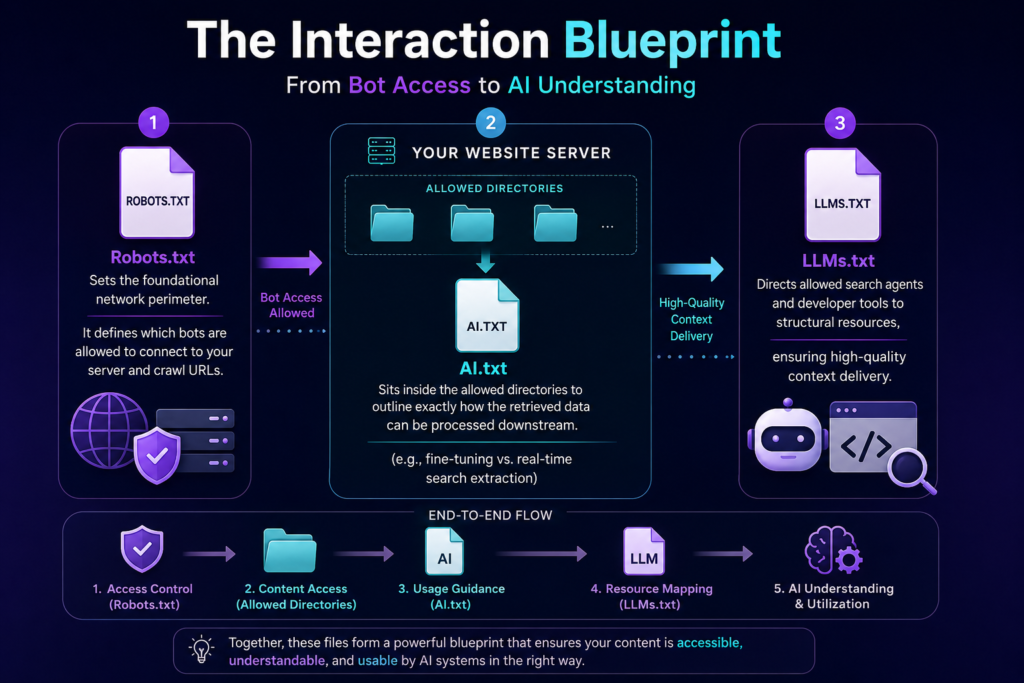
The 2026 Unified Crawler Configuration Blueprint
For a website like DigitianEra, managing visibility requires implementing a unified infrastructure. Below is a comprehensive configuration setup designed to balance visibility in AI search systems with protection against unauthorized training usage.
Part A: The Ground-Floor Defense (robots.txt)
Plaintext
# ROBOTS.TXT FOR DIGITIANERA (UNIFIED AI STRATEGY)
User-agent: *
Disallow: /wp-admin/
Disallow: /checkout/

# Strategy: Allow Live AI Search Engines for Citations and Referrals
User-agent: OAI-SearchBot
Allow: /
Disallow: /premium-analysis/

User-agent: ChatGPT-User
Allow: /

User-agent: Claude-SearchBot
Allow: /

User-agent: PerplexityBot
Allow: /

# Strategy: Block Aggressive Foundational Training Crawlers
User-agent: GPTBot
Disallow: /

User-agent: ClaudeBot
Disallow: /

User-agent: Google-Extended
Disallow: /

User-agent: CCBot
Disallow: /

# Link to our AI Discovery Guide
Sitemap: https://digitianera.com/sitemap.xml
Part B: The Downstream Governance Policy (AI.txt)
Plaintext
Version: 1.0
Base-URL: https://digitianera.com
Contact: legal@digitianera.com

Declaration: *
Model-Training: Disallow
Data-Mining: Disallow
Commercial-Licensing: Required
Licensing-Portal: https://digitianera.com/licensing

Declaration: OAI-SearchBot, Claude-SearchBot, PerplexityBot
RealTime-Retrieval: Allow
Citation-Requirement: Attribution-With-Link
Content-Caching: Temporarily-Allowed-For-Session
Part C: The High-Performance AI Directory (llms.txt)
Markdown
# DigitianEra - AI & Digital Transformation Intelligence
> High-authority perspectives, deep analytical essays, and technical documentation regarding AI paradigms, content governance, and web architectures.

## Foundational Content Guides
* [AI.txt vs LLMs.txt Technical Comparative Analysis](/blog/ai-txt-vs-llms-txt): The definitive operational guide analyzing data protection versus search visibility.
* [Enterprise GEO Frameworks](/guides/geo-strategy): Practical workflows for optimizing your technical architecture for Generative Engine discovery.

## Technical Specs & Tools
* [Open Crawler Monitor Log](/tools/crawler-log): Live platform mapping active bot signatures across global cloud systems.
* [Content Privacy API Interface](/api/privacy-endpoint): Developer parameters for programmatically managing digital media rights across decentralized hubs.
Strategic Business Impact: AEO, GEO, and Brand Survival
Why should content officers, chief marketers, and startup founders dedicate engineering hours to deploying these files? The answer lies in the shifting dynamics of search metrics. For over two decades, the key performance indicator (KPI) for digital visibility was the standard organic click-through rate (CTR). Today, brand reach is increasingly determined by Share of Voice in Generative Models.
The Impact on Answer Engine Optimization (AEO)
When users ask conversational systems complex business questions—such as “Which digital marketing platforms offer native compliance mapping for AI crawlers?”—the engine performs an on-the-fly evaluation. If your technical architecture relies exclusively on outdated, table-heavy HTML layouts, the engine’s extraction tool may experience contextual gaps. This can lead to inaccurate summaries or cause the bot to skip your site entirely in favor of an AI-optimized competitor.
By implementing a refined LLMs.txt asset, you bypass the extraction bottlenecks of modern RAG systems. You feed the model structured, clear facts, increasing the likelihood that your brand is selected as the definitive source.
Protecting Core Brand Valuation
Simultaneously, ignoring the governance framework of AI.txt exposes your company to asset dilution. If your business relies on proprietary data models or deep research insights, allowing foundation bots to scrape your site unchecked lets competitors duplicate your core insights. Balancing these two files ensures you protect your core business assets while maximizing visibility in modern search systems.
Future Outlook: The Evolution of Decentralized Machine Web Standards
The current framework of AI.txt vs LLMs.txt marks the beginning of an evolving paradigm in machine-to-machine web protocols. We are transitioning away from a human-centric web toward an ecosystem dominated by autonomous user agents, edge-compute models, and synthetic knowledge flows.
The Internet Engineering Task Force (IETF) is actively evaluating formal proposals via working groups like AIPREF (AI Preference Protocols). These groups aim to unify the scattered landscape of robots.txt extensions, AI.txt policies, and Markdown maps into a universally recognized protocol. Major Content Delivery Networks (CDNs) like Cloudflare, Fastly, and Akamai have already deployed automated solutions. These systems read machine-readable preferences at the edge, allowing webmasters to block unwanted training crawlers or monetize AI scraping through programmatic pay-per-crawl systems with a single click.
Conclusion: Actionable Blueprint for Webmasters
To keep your digital property secure and highly discoverable on the modern web, execute this five-step implementation framework immediately:
Perform a Content and Crawler Audit: Analyze your server logs to isolate exactly which bots (e.g., GPTBot, PerplexityBot) are accessing your site, noting their crawl frequencies and bandwidth consumption.
Update your Robots.txt File: Explicitly separate live search retrieval tools (which drive active traffic) from background training crawlers (which ingest data without click-throughs).
Deploy your AI.txt File: Publish a clear AI.txt asset to your root directory to declare your data-use policies for legal and automated compliance audits.
Build a Dynamic LLMs.txt File: Create a clean, high-value Markdown overview at
[yourdomain.com/llms.txt](https://yourdomain.com/llms.txt)that outlines your site’s structure, primary resources, and key brand offerings.Monitor Generative Metrics: Track your referrals from systems like ChatGPT, Perplexity, and Claude alongside your standard Google Search Console data to refine your optimization strategy over time.
Contact Digitianera today for a free SEO consultation and discover how our customized real estate SEO strategies can help your business grow faster without relying on expensive advertising campaigns.
FAQs
No. The primary objective of LLMs.txt is real-time content discovery, context enrichment, and Retrieval-Augmented Generation (RAG) optimization. It helps live search engines and developer tools accurately read your site’s information. To prevent AI companies from using that same data to train foundational models, you must use restrictive declarations in your robots.txt and AI.txt files to establish clear usage boundaries.
While robots.txt remains the only file with absolute technical enforcement capabilities at the network layer, it operates on a simple binary approach (either blocking or allowing a bot entirely). It cannot handle complex downstream guidelines. AI.txt lets you declare nuanced data rights (such as allowing live search citations while forbidding foundational training weights ingestion), while LLMs.txt provides a streamlined Markdown roadmap to maximize your brand’s visibility in conversational AI answers
The llms.txt file serves as a high-level, human- and machine-readable index or directory located at the root of your website, containing brief summaries and clean links to your most important resources. Conversely, llms-full.txt is an optional secondary file (or a collection of backend endpoints) that provides the full, raw text content of those resources in clean, unbloated Markdown, making it incredibly easy for an AI agent to ingest the complete context quickly.
Currently, AI.txt operates as a machine-readable declaration of your digital rights and data preferences rather than a rigid firewall. However, it serves as a crucial legal benchmark for data auditing compliance and copyright protection. As global web standard initiatives like the IETF AIPREF group evolve, these preferences are expected to integrate into legally binding data scraping protocols and edge-compute filters managed by major CDNs.
In the era of AI-driven search, standard SEO is expanding into Generative Engine Optimization (GEO) and Answer Engine Optimization (AEO). Traditional web pages are often filled with code bloat (JavaScript, sidebars, tracking pixels) that degrades AI retrieval pipelines. By offering an optimized, clean Markdown file via LLMs.txt, you eliminate these data extraction bottlenecks, significantly increasing the probability that an AI engine will accurately source, summarize, and link back to your brand.