
- Written by: Naveen Singh
- June 15, 2026
- Categories: Blog, Local SEO, SEO Strategy
- Tags: , Amazon SEO, Digital Commerce, Digitianera Services, E-commerce Marketing, Flipkart Seller Tips, Marketplace Optimization, MPO, Online Marketplaces, ROI Optimization
Marketplace Optimization (MPO) Services: Boost Visibility, Sales & ROI Across Leading Marketplaces
E-commerce has evolved far beyond having a single website. Today, the real battlegrounds for sales are the major online marketplaces Amazon, Flipkart, Myntra, Meesho, Walmart, eBay, Etsy, and dozens of niche platforms that cater to specific industries and audiences. Brands Management that once relied solely on their own websites are now discovering that marketplaces account for the majority of their online revenue. However, simply listing products on these platforms is not enough. Without proper optimization, even the best products can get buried under thousands of competing listings, resulting in poor visibility, low conversion rates, and wasted advertising spend.
This is where Marketplace Optimization (MPO) Services come in. MPO is a specialized discipline that combines elements of SEO, content strategy, advertising management, data analytics, and platform-specific best practices to ensure that a brand’s presence on any marketplace is fully optimized for discoverability, trust, and conversions. At Digitianera, we help businesses of every size from small sellers just starting out to established enterprises managing thousands of SKUs, unlock the full potential of marketplace selling.
In this comprehensive guide, we’ll explore what Marketplace Optimization really means, why it matters more than ever in 2026, the core components of a winning MPO strategy, platform-specific considerations, common mistakes sellers make, and how partnering with an experienced agency like Digitianera can transform your marketplace performance.
What Is Marketplace Optimization (MPO)?
Marketplace Optimization refers to the systematic process of improving every element of a seller’s presence on an online marketplace to maximize visibility in search results, improve click-through rates, increase conversions, and ultimately drive higher sales and return on investment (ROI).
Unlike traditional website SEO, which focuses on ranking in Google’s search results, MPO focuses on ranking within a marketplace’s own internal search engine often called an “A9” algorithm in Amazon’s case, or similar proprietary ranking systems on Flipkart, Walmart, and other platforms. These algorithms consider a unique mix of factors: keyword relevance, sales velocity, pricing competitiveness, customer reviews, fulfillment method, image quality, and more.
MPO is not a one-time task. It’s an ongoing process of testing, refining, and adapting to algorithm changes, seasonal trends, competitor movements, and shifting consumer behavior. A truly effective MPO strategy touches nearly every aspect of a seller’s account, including:
- Product listing content (titles, bullet points, descriptions)
- Image and video assets
- Backend search terms and keyword indexing
- Pricing and promotional strategy
- Inventory and fulfillment management
- Customer reviews and ratings management
- Advertising campaigns (PPC/sponsored ads)
- Brand storefront and A+ Content
- Competitor analysis and benchmarking
- Analytics and performance reporting
When all of these elements work together cohesively, the result is a marketplace presence that consistently outperforms competitors, even in highly saturated categories.
Why Marketplace Optimization Matters More Than Ever?
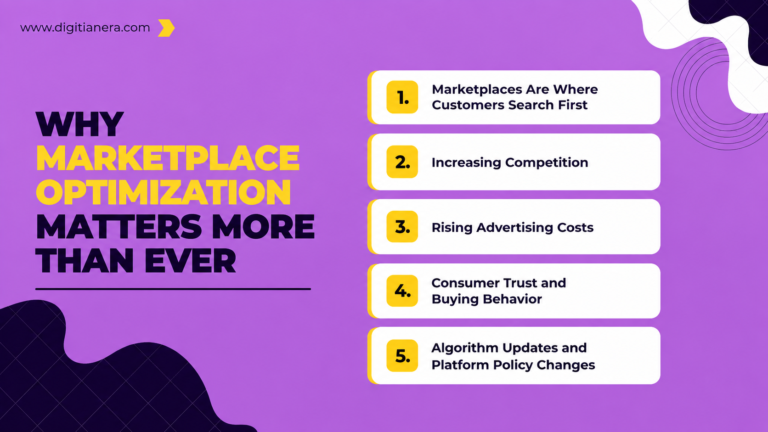
1. Marketplaces Are Where Customers Search First
When all of these elements work together cohesively, the result is a marketplace presence that consistently outperforms competitors, even in highly saturated categories.
2. Increasing Competition
Every year, more sellers join major marketplaces, increasing competition exponentially. Categories that were once easy to rank in are now crowded with hundreds or thousands of similar products. Without optimization, new or under-optimized listings simply cannot compete against established sellers who have already mastered the algorithm.
3. Rising Advertising Costs
As competition increases, so does the cost of sponsored advertising on these platforms. Many sellers try to compensate for poor organic visibility by throwing more money at ads — but this is an unsustainable strategy. A well-optimized listing reduces dependency on paid advertising by improving organic ranking, which directly improves your overall ROI and lowers your Advertising Cost of Sales (ACoS).
4. Consumer Trust and Buying Behavior
Today’s consumers are more discerning than ever. They read reviews, compare prices across multiple listings, examine product images closely, and check seller ratings before making a purchase decision. A poorly presented listing — even with a great product — can lose the sale to a competitor with better visuals, clearer information, and stronger social proof.
5. Algorithm Updates and Platform Policy Changes
Marketplace algorithms are not static. Amazon, Flipkart, and others regularly update their ranking criteria, search relevance models, and policy requirements. Sellers who don’t keep pace with these changes risk sudden drops in visibility, suppressed listings, or even account suspensions. Ongoing optimization ensures compliance and adaptability.
Core Components of a Winning MPO Strategy
1. Keyword Research and Search Term Optimization
Keyword research is the foundation of marketplace optimization. Unlike general web SEO, marketplace keyword research must focus specifically on the search terms shoppers use within that platform — which often differ significantly from how people search on Google.
A thorough MPO keyword strategy involves:
Seed keyword identification: Understanding the core terms that describe your product category.
Long-tail keyword discovery: Finding specific phrases that capture buyer intent (e.g., “stainless steel water bottle 1 litre leak proof” rather than just “water bottle”).
Competitor keyword analysis: Identifying which keywords top-ranking competitors are using and finding gaps you can exploit.
Search volume and relevance balancing: High search volume is meaningless if the keyword isn’t relevant to your product — relevance always comes first.
Backend search term optimization: Many platforms allow hidden search terms that aren’t visible to customers but help with indexing. These need to be used strategically without keyword stuffing, which can trigger penalties.
At Digitianera, our keyword research process combines marketplace-specific tools, manual search analysis, and competitor benchmarking to build a keyword map that informs every other element of the listing.
2. Product Title Optimization
The product title is arguably the single most important element of any marketplace listing. It’s the first thing shoppers see in search results, and it carries significant weight in the ranking algorithm.
An optimized title typically includes:
- The primary keyword near the beginning
- Brand name (where appropriate and per platform guidelines)
- Key product attributes (size, color, quantity, material)
- Important differentiators (e.g., “waterproof,” “pack of 3,” “with warranty”)
However, titles must also remain readable and not feel like a jumbled list of keywords. Each marketplace has its own character limits and formatting guidelines, and violating these can result in listing suppression. Our team crafts titles that strike the perfect balance between SEO value and human readability.
3. Bullet Points and Product Descriptions
Bullet points (or feature highlights) serve two purposes: they communicate key product benefits to shoppers quickly, and they provide additional keyword indexing opportunities.
Effective bullet points should:
- Lead with the most compelling benefit, not just a feature
- Address common customer questions or concerns
- Use natural language that incorporates secondary keywords
- Be scannable — shoppers rarely read dense paragraphs
4. Image and Video Optimization
Visual content is one of the most powerful conversion drivers on any marketplace. Studies consistently show that listings with high-quality, multiple images and video content significantly outperform those with minimal or low-quality visuals.
A complete MPO image strategy includes:
- Main image optimization: Clean, high-resolution images on the required background (often white) that meet platform specifications exactly.
- Lifestyle and contextual images: Showing the product in use, in real-world settings, to help customers visualize ownership.
- Infographic-style images: Highlighting dimensions, materials, features, and comparisons directly within the image.
- Size charts and comparison charts: Especially critical for apparel, footwear, and accessories.
- Video content: Short product demonstration videos that showcase functionality, unboxing, or usage tips.
Many sellers underestimate how much a single image refresh can impact conversion rates. We’ve seen cases where simply updating the main image and adding infographics increased conversion rates substantially without any change to price or advertising spend.
5. A+ Content / Enhanced Brand Content
For brand-registered sellers, platforms like Amazon offer enhanced content modules (often called A+ Content) that allow for rich, visually engaging product pages featuring comparison charts, lifestyle imagery, brand storytelling, and modular layouts.
A+ Content has been shown to improve conversion rates and reduce return rates because it provides shoppers with more comprehensive information before purchase. It also contributes to a more premium brand perception, which can support higher price points.
6. Pricing and Promotional Strategy
Pricing plays a dual role in marketplace optimization — it affects both the algorithm’s perception of your listing’s competitiveness and the shopper’s purchase decision.
Key pricing considerations include:
- Competitive benchmarking: Regularly monitoring competitor pricing to ensure you remain competitive without unnecessarily eroding margins.
- Dynamic pricing strategies: Adjusting prices based on demand, time of day, inventory levels, or competitor actions.
- Promotional campaigns: Strategic use of discounts, coupons, lightning deals, and bundle offers to boost visibility during key sales events.
- Psychological pricing: Leveraging pricing structures (e.g., ending prices in .99 or .49) that have been shown to influence purchase behavior.
7. Reviews and Ratings Management
Customer reviews are one of the strongest trust signals on any marketplace, and they directly influence both conversion rates and search ranking. Listings with higher review counts and ratings tend to rank better and convert at higher rates.
An effective reviews strategy includes:
- Proactive review generation: Using platform-compliant methods to encourage satisfied customers to leave reviews.
- Review monitoring: Tracking new reviews daily to catch and address negative feedback quickly.
- Responding to reviews: Where platforms allow, responding professionally to both positive and negative reviews demonstrates active brand engagement.
- Quality control feedback loop: Using review insights to identify and fix recurring product issues before they damage your rating further.
8. Sponsored Advertising (PPC) Management
While organic optimization is the foundation, PPC Strategy and sponsored advertising campaigns remain a critical accelerator — especially for new product launches or highly competitive categories.
Effective PPC management within an MPO strategy involves:
Campaign structure: Organizing campaigns by match type, product category, and strategic goal (e.g., brand defense, competitor targeting, category domination).
Keyword bidding strategy: Balancing aggressive bids on high-converting keywords with cost-efficient bids on broader terms.
Negative keyword management: Continuously refining negative keyword lists to prevent wasted spend on irrelevant searches.
ACoS and TACoS monitoring: Tracking Advertising Cost of Sales and Total Advertising Cost of Sales to ensure campaigns remain profitable.
Seasonal campaign adjustments: Scaling budgets up during peak shopping periods and pulling back during slower months.
The synergy between organic optimization and paid advertising cannot be overstated. A well-optimized listing makes every advertising dollar work harder because it converts better once the click arrives.
9. Inventory and Fulfillment Optimization
Stock availability and fulfillment speed are increasingly important ranking factors. Marketplaces favor listings that demonstrate reliable stock levels and fast shipping — particularly those enrolled in premium fulfillment programs (such as Fulfilled by Amazon, Flipkart’s fulfillment services, etc.).
Inventory optimization within MPO includes:
- Demand forecasting to prevent stockouts during high-traffic periods
- Strategic use of fulfillment programs to qualify for premium shipping badges
- Multi-warehouse distribution planning to reduce delivery times across regions
- Buy Box / Winning Listing eligibility management, which is often tied to fulfillment performance metrics
10. Storefront and Brand Presence
Many marketplaces allow brands to create dedicated storefronts — essentially mini-websites within the marketplace ecosystem. Supporting marketplace activity with Social Media Marketing can also help brands increase product awareness and drive additional traffic to their listings.
A well-designed storefront:
- Improves brand credibility and trust
- Encourages cross-selling and upselling between products
- Provides an additional destination for advertising traffic
- Can be customized seasonally to align with promotions or new launches
Platform-Specific MPO Considerations
While the core principles of marketplace optimization remain consistent, each platform has unique algorithms, policies, and best practices.
Amazon
Amazon’s A9 (and increasingly A10) algorithm places heavy emphasis on sales velocity, keyword relevance in titles and backend search terms, click-through rate, conversion rate, and fulfillment method. Brand registry unlocks powerful tools like A+ Content, Brand Stores, and Sponsored Brands advertising. Amazon also places significant weight on review quality and recency.
Flipkart
Flipkart’s search algorithm rewards sellers with strong “Listing Quality Scores,” which take into account image quality, content completeness, pricing competitiveness, and seller performance metrics like order defect rate and shipping speed. Flipkart’s F-Assured badge (similar to Amazon’s Prime) can significantly boost trust and visibility.
Myntra
For fashion and lifestyle brands, Myntra’s algorithm heavily weighs visual content quality, size and fit information, and style tagging. Detailed size charts and model imagery showing the product worn are critical for reducing returns and improving rankings.
Meesho
Meesho’s reseller-driven model means pricing competitiveness and rapid catalog updates are especially important. Optimizing for Meesho often involves simplified, highly visual listings that resellers can easily share across social platforms.
Walmart and eBay
For sellers expanding internationally, Walmart Marketplace and eBay each have their own ranking systems that reward content completeness, competitive pricing (Walmart in particular rewards price competitiveness aggressively), and seller performance metrics like shipping accuracy and return rates.
Etsy
For handmade, vintage, and craft sellers, Etsy’s search algorithm rewards listing quality scores based on tags, titles, descriptions, and — importantly — recency and engagement signals like favorites and views relative to impressions.
Navigating these platform-specific nuances requires deep familiarity with each marketplace’s evolving algorithm and policy landscape — something that a dedicated MPO partner like Digitianera continuously monitors so you don’t have to.
Common Marketplace Optimization Mistakes
Even experienced sellers fall into common traps that limit their marketplace performance:
- Keyword Stuffing: Cramming as many keywords as possible into titles and descriptions, often at the expense of readability, can trigger algorithm penalties and turn off shoppers.
- Ignoring Mobile Optimization: A majority of marketplace shopping happens on mobile devices. Listings that look great on desktop but display poorly on mobile — with cut-off titles or unreadable infographics — lose significant conversions.
- Inconsistent Branding Across Listings: When product listings within the same brand look completely different from one another, it erodes trust and brand recognition.
- Neglecting Backend Optimization: Many sellers focus only on what’s visible to customers and ignore backend search terms, category placement, and attribute fields — all of which significantly impact discoverability.
- Reactive Rather Than Proactive Pricing: Failing to monitor competitor pricing regularly can result in listings becoming uncompetitive without the seller even realizing it.
- Treating Optimization as a One-Time Task: Perhaps the biggest mistake of all — optimizing a listing once at launch and never revisiting it, even as algorithms, competitors, and consumer behavior evolve.
- Underinvesting in Reviews Strategy: Allowing negative reviews to accumulate unaddressed, or failing to encourage satisfied customers to share feedback, directly harms both trust signals and ranking.
- Disconnected Advertising and Organic Strategies: Running PPC campaigns without aligning them to organic keyword strategy results in wasted spend and missed opportunities to reinforce ranking signals.
The Digitianera Approach to Marketplace Optimization
At Digitianera, we believe that marketplace success isn’t about chasing quick wins or gaming algorithms — it’s about building a sustainable, data-driven optimization framework that compounds in value over time. Our MPO services are designed to be comprehensive, transparent, and tailored to each client’s specific category, competitive landscape, and growth goals.
Our Process
Step 1: Comprehensive Account and Listing Audit We begin every engagement with a thorough audit of your existing marketplace presence — analyzing current listings, keyword rankings, advertising performance, review profiles, and competitor positioning. This audit identifies quick wins as well as longer-term strategic opportunities.
Step 2: Keyword Strategy and Content Overhaul Using our research process, we rebuild product titles, bullet points, descriptions, and backend search terms to maximize relevance and discoverability — without sacrificing readability or brand voice.
Step 3: Visual Content Enhancement Our creative team produces optimized main images, lifestyle photography concepts, infographics, and A+ Content modules designed to convert browsers into buyers.
Step 4: Advertising Campaign Architecture We design and manage PPC campaigns structured around your optimized keyword strategy, continuously refining bids, budgets, and targeting to improve ROI.
Step 5: Reviews and Reputation Management We implement compliant review generation strategies and establish monitoring systems to respond quickly to customer feedback.
Step 6: Ongoing Monitoring and Iteration Marketplace optimization is never “done.” We provide regular performance reporting, competitor monitoring, and strategic adjustments to keep your listings ahead of algorithm changes and market shifts.
What Sets Digitianera Apart
- Multi-Platform Expertise: Whether you’re selling on Amazon, Flipkart, Myntra, Meesho, or international platforms, our team understands the unique requirements of each.
- Data-Driven Decision Making: Every recommendation we make is backed by data — keyword research, competitor analysis, and performance metrics — not guesswork.
- Transparent Reporting: We provide clear, regular reports showing exactly how our optimization efforts are translating into visibility improvements, conversion gains, and ROI.
- Dedicated Account Management: Each client works with a dedicated team that understands their brand, category, and goals — not a rotating cast of generalists.
- Scalable Solutions: Whether you’re managing 10 SKUs or 10,000, our processes scale to match your catalog size and complexity.
Measuring Success: Key Metrics in Marketplace Optimization
A successful MPO engagement should be measurable. Here are the key performance indicators we track for clients:
- Organic ranking position for target keywords
- Click-through rate (CTR) from search results to product pages
- Conversion rate from page views to purchases
- Total sales revenue and unit growth
- Advertising Cost of Sales (ACoS) and Total ACoS (TACoS)
- Review count and average rating trends over time
- Buy Box win rate (where applicable)
- Return rate as an indicator of listing accuracy
- Storefront traffic and engagement metrics
By tracking these metrics consistently, we can demonstrate clear ROI from optimization efforts and continuously refine strategy based on what’s actually working.
The Future of Marketplace Optimization
As marketplaces continue to evolve, several trends are shaping the future of MPO:
AI-Powered Search and Recommendations: Marketplace search algorithms are increasingly leveraging AI to understand search intent more holistically, moving beyond simple keyword matching toward semantic understanding. This means content quality and relevance will matter even more than exact keyword placement.
Video and Interactive Content: Short-form video content embedded directly in listings is becoming a major differentiator, particularly as platforms integrate more social-commerce-style features.
Sustainability and Transparency Signals: Increasingly, consumers — and platforms — are highlighting sustainability credentials, ethical sourcing, and transparency badges, which may become additional ranking and trust factors.
Cross-Platform Strategy Integration: Brands are increasingly managing unified strategies across multiple marketplaces simultaneously, requiring optimization approaches that account for cross-platform consistency while respecting each platform’s unique requirements.
Personalization at Scale: As marketplaces personalize search results based on individual shopper behavior, optimization will need to account for broader relevance signals that appeal across diverse customer segments.
Staying ahead of these trends requires a partner who is constantly researching, testing, and adapting — exactly the role Digitianera plays for our clients.
Frequently Asked Questions (FAQs)
What are the 5 core marketplace concepts?
The five core marketplace concepts are product visibility, listing optimization, customer trust, competitive pricing, and marketplace performance. Together, these factors help sellers improve discoverability, conversions, and overall marketplace performance.
How can I optimize my Facebook Marketplace listing?
You can optimize a Facebook Marketplace listing by using a clear, keyword-relevant title, high-quality product images, an accurate description, competitive pricing, and complete product details. Keeping listings updated can also help maintain visibility.
Do I need SEO optimization?
Yes. SEO optimization can help improve your visibility in search results and attract relevant visitors. For marketplace sellers, Marketplace Optimization (MPO) works alongside traditional SEO by focusing on visibility within marketplace search systems.
What are the top 3 online marketplaces?
The leading online marketplaces vary by country, product category, and target audience. Platforms such as Amazon, Walmart, and eBay are among the major marketplaces used by sellers globally.
What is the difference between SEO and Marketplace Optimization (MPO)?
SEO focuses on improving visibility in search engines like Google, while Marketplace Optimization focuses on improving product visibility, rankings, and conversions within online marketplaces.
Conclusion
In today’s hyper-competitive e-commerce landscape, simply having a presence on major marketplaces is no longer enough. Visibility, trust, and conversions must be earned through deliberate, ongoing optimization across every element of your listings — from keywords and content to images, pricing, reviews, and advertising.
Marketplace Optimization (MPO) Services are not a luxury reserved for large enterprises; they are an essential investment for any business serious about growing its marketplace revenue and maximizing ROI. The difference between a listing that languishes on page three of search results and one that dominates the first page often comes down to the depth and consistency of optimization efforts behind it.
At Digitianera, we’ve built our MPO services around a simple philosophy: combine deep platform expertise, data-driven strategy, and creative excellence to help our clients win — not just once, but continuously, as marketplaces and consumer behavior evolve.
If you’re ready to boost your visibility, increase your sales, and maximize your ROI across leading marketplaces, Digitianera is here to help you build a marketplace presence that doesn’t just compete — it leads. Digitianera best marketing Agency
Ready to optimize your marketplace presence? Get in touch with Digitianera today and discover how our Marketplace Optimization Services can transform your e-commerce performance.